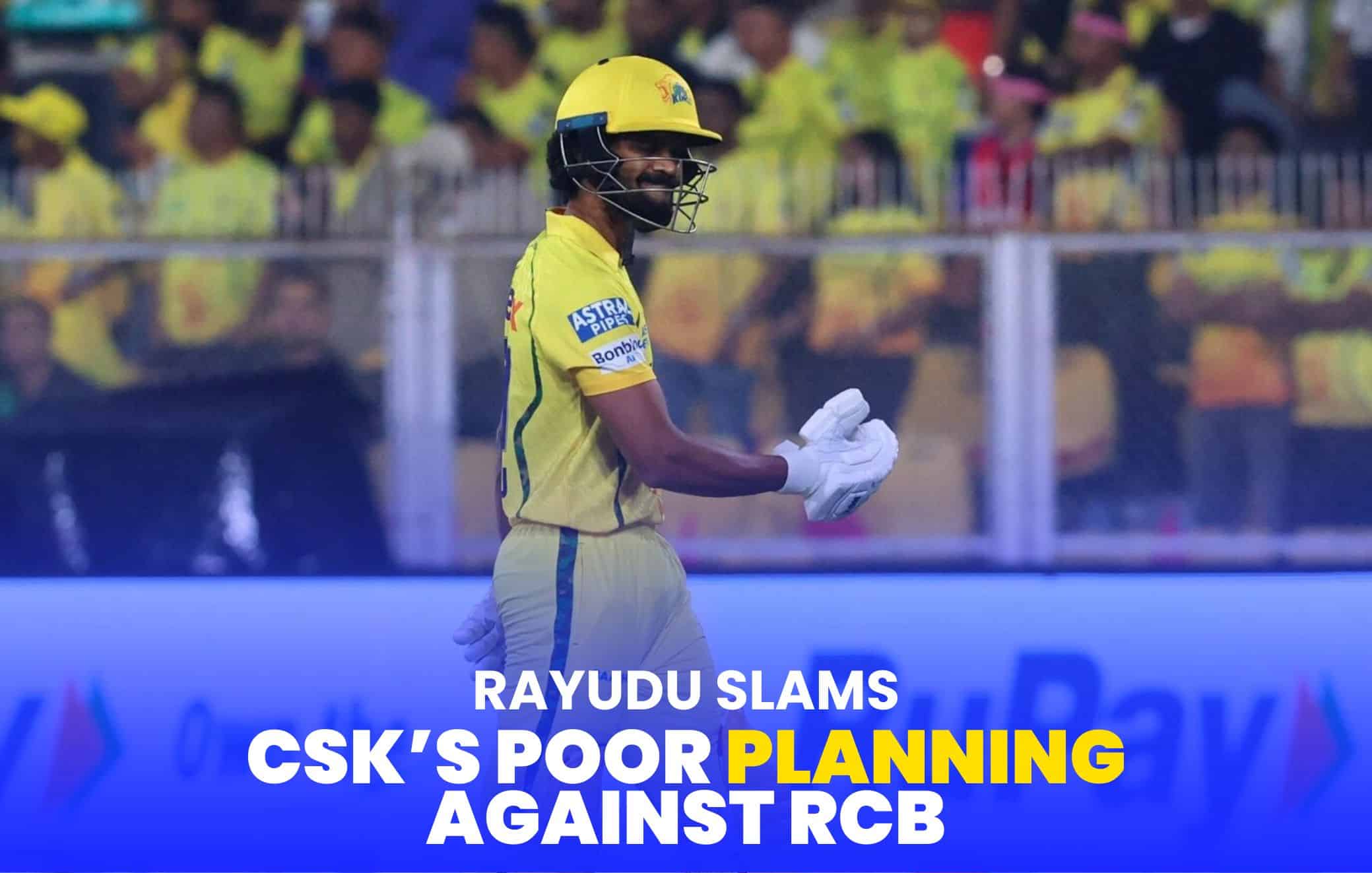
Rayudu slammed CSK’s planning against RCB after their 43-run loss in IPL 2026, stating that the team “just stuck to that bad plan.” With Chennai Super Kings losing all three of their opening matches and Royal Challengers Bangalore winning both of theirs, the gulf in preparation and execution was evident on Sunday night in Bengaluru.
CSK’s Struggles in Death Overs
CSK were in contention for most of the first innings, but the match swung dramatically against them in the death overs. Tim David’s explosive hitting exposed weaknesses in Chennai’s bowling strategy, highlighting poor planning and lack of flexibility. The 16th over, which started with RCB at 153 for 3, exemplified the collapse, as runs flowed freely: Khaleel Ahmed conceded 19, Noor Ahmad 21, Anshul Kamboj 14, Jamie Overton 30, and Kamboj again 13. Only Kamboj managed to hold his composure under pressure.
Finch on Planning vs Execution
Aaron Finch highlighted the dual problem of planning and execution. “For me, as a captain, you can always understand poor execution. If the plan is right and the bowler has bought into it, and they mis-execute, that’s okay. But was the planning right? I don’t think it was. Was the execution right? No, it absolutely wasn’t. So when you miss both, that’s worrying signs,” Finch said on ESPNcricinfo’s TimeOut show.
According to Finch, sticking rigidly to a flawed strategy without adapting to the match scenario can quickly lead to chaos. “I’ve been in that situation as a captain where you’re thinking: what’s happening? And before you know it, that over’s gone and you’ve forgotten to rejig your plans,” he explained.
Rayudu Criticizes Sticking to a Bad Plan
Ambati Rayudu went further, asserting that CSK’s failure wasn’t just execution but the refusal to adjust a flawed plan. “More than a bad plan, they just stuck to that bad plan. There was nobody to intervene and take 20-30 seconds to guide the bowler with a message,” he said. Rayudu emphasized that slowing down and communicating with bowlers could have mitigated the damage in the death overs.
He also pointed to the lack of follow-up deliveries after boundaries or sixes. “Generally, as a bowler, you need to be aware that after being hit for a six, the next ball matters. Good death bowlers always follow up with a very good ball,” he explained. While CSK’s powerplay and middle-overs bowling was decent, the death overs remain their Achilles’ heel.
Issues with Bowling Angles
The around-the-wicket bowling strategy, which CSK has used in other leagues like MLC and SA20, was not implemented at the death in this match. “MSD didn’t approve of that sort of an angle at the death,” Rayudu revealed. Analysts noted that this decision contributed to RCB’s dominance in the later stages of the innings.
RCB’s Superior Flexibility and Execution
RCB, in contrast, executed plans with precision. “They are a team that’s making the right decision at the right time,” Finch said. “They’ve been flexible, not rigid, in their preparation and planning, and it’s showing on the field.” Every bowler and fielding position was designed to control the game, and their adaptability allowed them to capitalize on CSK’s mistakes.
Rayudu also noted RCB’s proactive approach: “They’re not letting anything just pass by; they just want to control every scenario, every over.” This clear tactical advantage, combined with power hitters like Tim David, created a mismatch in the final overs that CSK could not overcome.
Implications for CSK
CSK’s inability to adjust their strategy raises serious concerns for the rest of IPL 2026. Poor planning combined with weak execution in high-pressure moments could cost them more matches if not addressed. Both Finch and Rayudu emphasized the need for flexibility, better communication, and quick decision-making in crucial overs, especially against aggressive teams like RCB.
Conclusion
The 43-run loss to RCB exposed the flaws in CSK’s bowling strategies and decision-making processes. Rayudu’s criticism of “sticking to a bad plan” and Finch’s concerns about execution highlight the need for immediate strategic adjustments.
Meanwhile, RCB’s flexible, calculated approach demonstrates the importance of adaptability and real-time decision-making in modern T20 cricket. For CSK, the path forward in IPL 2026 will require a reassessment of planning, execution, and in-game adaptability if they are to compete with the top teams.
Written by 8JJ.com | April 6,2026
Stay updated with 8JJ for Real-Time Sports Scores & Sports Related Updates
🔗 Visit our other platforms:
8jjSports.com