Rishabh Pant and the price tag that reshaped IPL 2026 perception
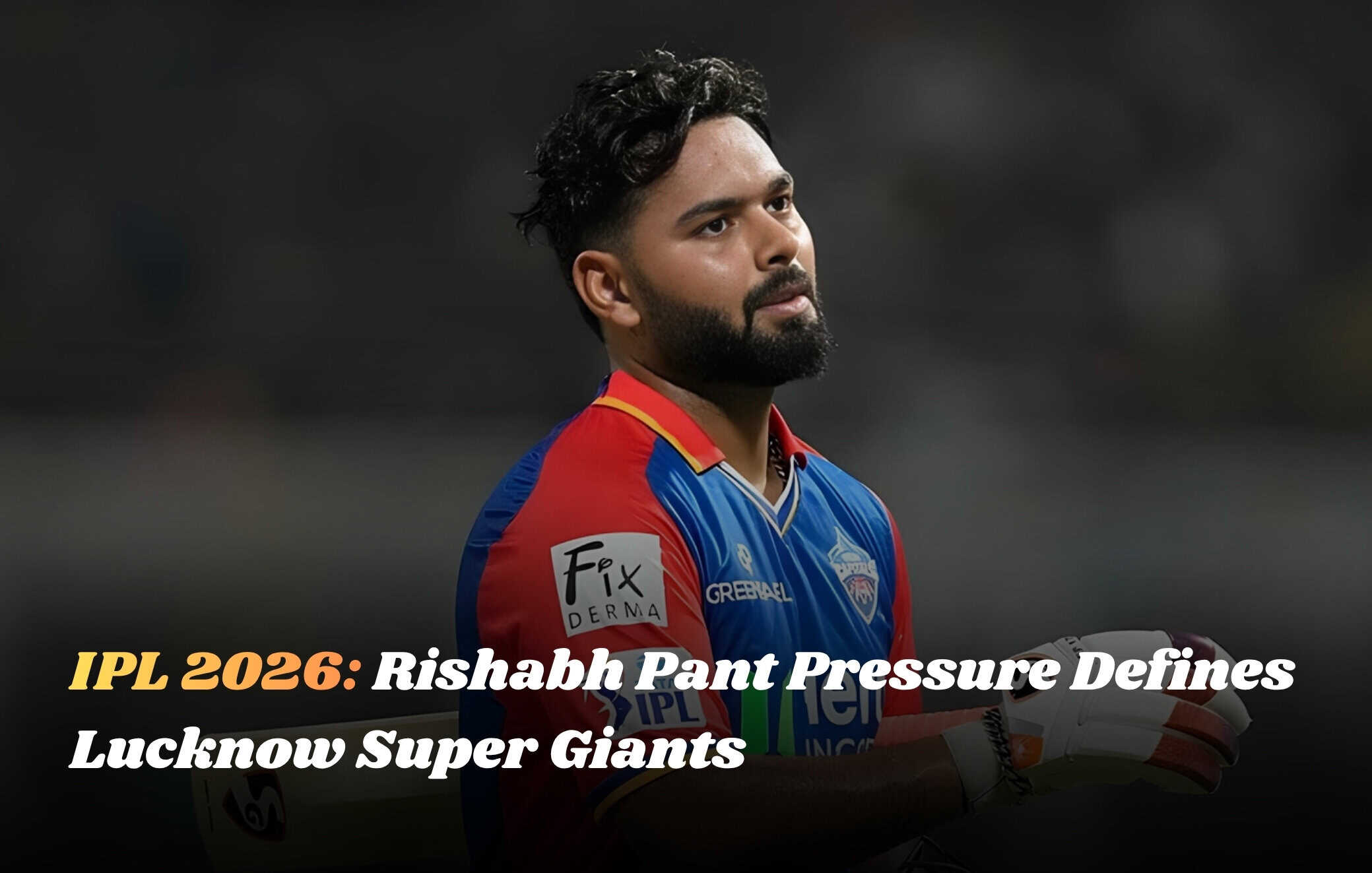
Captain of the Lucknow Super Giants Rishabh Pant enters IPL 2026 in a position very few players in franchise cricket history have experienced at this scale. The Rs 27 crore valuation attached to his name when Lucknow Super Giants secured him did not just make him the most expensive player in IPL history. It redefined how every single innings of his career is now interpreted. In elite sport, price is not just compensation. It becomes a psychological framework that influences expectation, scrutiny, and tactical judgment.
In the context of IPL 2026, this valuation is no longer a headline from an auction cycle. It has evolved into an ongoing reference point that follows Pant into every match environment. Every dismissal is weighted differently. Every failure is magnified through financial expectation. Even his successful innings are filtered through the lens of whether they reflect “value” rather than just contribution.
This is where Lucknow Super Giants face a structural psychological challenge. They did not just acquire a captain or a wicketkeeper batter. They acquired a high-involvement economic asset whose performance is now tied to perception cycles that extend far beyond the boundary rope.
The psychology of elite valuation pressure in franchise cricket
In modern IPL ecosystems, valuation psychology plays a far greater role than most traditional cricket analysis acknowledges. A player bought at an extreme price point does not just carry expectation from fans or media. They carry internal expectation pressure from team strategy itself.
For Rishabh Pant in IPL 2026, this means his role is not just to perform but to validate investment logic. That subtle distinction changes how innings are constructed and interpreted. A 30-run cameo is no longer neutral. It becomes a discussion point about efficiency. A slow start is no longer tactical caution. It becomes narrative pressure.
Faf du Plessis’ observation about Pant being under the most pressure in the tournament is rooted in this exact structure. The pressure is not episodic. It is continuous, embedded in every phase of the competition.
Why IPL 2026 amplifies expectation cycles more than previous seasons
The IPL as a competition has evolved into a system where expectation cycles are faster and more unforgiving. In earlier seasons, players were often given longer adaptation windows. In IPL 2026, performance evaluation begins almost immediately and compounds rapidly.
For Pant, this creates a compressed feedback loop. One poor performance does not sit in isolation. It immediately interacts with previous output, price tag narrative, and leadership responsibility. This creates what analysts often describe as stacked pressure layers.
The focus keyword IPL 2026 becomes important here because this season is structurally different in how it handles high-value players. Data-driven analysis, instant comparison metrics, and constant media cycles ensure that players like Pant are under continuous evaluation rather than periodic assessment.
The dual identity problem: captaincy and performance accountability
Rishabh Pant’s situation is further complicated by his dual role as both captain and frontline batter. In franchise cricket, these roles are individually demanding. When combined, they create a layered accountability structure.
As captain, Pant is responsible for tactical decision making, field adjustments, and managing bowling resources. As a batter, he is expected to anchor innings, accelerate scoring, and deliver under pressure situations. These two roles often require different mental states. One demands macro-level control, the other demands micro-level execution.
In IPL 2026, this dual identity becomes central to understanding his pressure environment. When performance dips in one area, it does not remain isolated. It affects perception in the other. A poor batting run begins to question leadership stability. A tactical misstep begins to influence batting criticism.
This interconnected scrutiny is what makes his position structurally different from most players in the league.
Lucknow Super Giants and the dependency imbalance
From a team construction perspective, Lucknow Super Giants enter IPL 2026 with a system that places significant weight on their captain’s output. This is not unusual in franchise cricket, but it becomes critical when the captain is also the most expensive player in tournament history.
When a team builds around such a figure, performance dependency naturally increases. The batting order often stabilizes around the captain’s position. Tactical confidence flows through their presence at the crease. Even opposition planning begins to factor in how early or late he arrives at the crease.
This creates a situation where individual form directly influences collective rhythm. If Pant scores heavily, LSG appear balanced and dominant. If he struggles, the entire structure appears exposed, regardless of how other players perform.
Early narrative pressure heading into IPL 2026
As IPL 2026 begins, Pant’s situation is not defined by uncertainty about ability. It is defined by certainty of expectation. Everyone knows what he is capable of at his peak. The question is whether that peak can be accessed consistently under compounded pressure.
Faf du Plessis’ remark does not introduce new pressure. It simply verbalizes what already exists within the system. The real challenge for Pant is not external commentary, but internal expectation alignment.
Lucknow Super Giants are not just entering a tournament. They are entering a validation cycle for one of the most expensive investments in IPL history. And in that environment, every innings becomes a data point, every decision becomes a reference, and every performance becomes part of a larger narrative that defines IPL 2026 for both player and franchise.
Faf du Plessis reframes Rishabh Pant through a pressure lens, not a form debate
Faf du Plessis’ assessment of Rishabh Pant ahead of IPL 2026 does not function as a typical commentary on batting form. It operates more like a structural diagnosis of pressure in modern franchise cricket. By identifying Pant as potentially the most pressured player in the tournament, du Plessis shifts the conversation away from statistics and into psychological architecture.
In elite cricket analysis, this distinction matters. Form fluctuates across matches and seasons, but pressure systems are persistent. They follow players regardless of short term performance. In the case of IPL 2026, Pant is not simply responding to last season’s numbers. He is operating inside a continuously expanding expectation environment.
The focus keyword IPL 2026 is important here because this season intensifies all existing pressure layers rather than resetting them. What happened in previous seasons is not erased. It is accumulated, processed, and reinterpreted through every new performance.
Understanding pressure as a layered system in franchise cricket
Pressure in modern T20 cricket is no longer a single emotional state. It functions as a layered system made up of financial expectation, leadership responsibility, media scrutiny, and team dependency. For Rishabh Pant, all four layers are active simultaneously.
The first layer is financial valuation. The Rs 27 crore price tag places Pant at the highest economic tier of IPL history. This alone creates constant comparison with output expectations. Every innings is measured against investment logic, not just match context.
The second layer is leadership responsibility. As captain of Lucknow Super Giants, Pant is required to manage tactical decisions under rapid game conditions. This includes bowling rotations, field adjustments, and momentum control. These responsibilities exist regardless of his batting performance in a given match.
The third layer is public and media scrutiny. In IPL ecosystems, narrative momentum builds quickly. A poor performance does not remain isolated. It becomes part of an ongoing storyline that shapes perception heading into the next match.
The fourth layer is team dependency. LSG’s structure places significant importance on Pant’s batting stability. When a team builds its core identity around a single high-impact player, that player becomes a reference point for both success and failure.
These four layers combine to form what can be described as a pressure architecture rather than a simple pressure situation.
Why elite players respond differently to stacked expectation environments
Faf du Plessis’ commentary also highlights a key behavioral truth in elite sport. Not all players respond to pressure in the same way. Some athletes elevate performance under expectation, while others experience performance volatility when pressure layers accumulate.
In Pant’s case, IPL 2026 becomes a test of stability rather than ability. His technical skills as a wicketkeeper batter are well established. The variable now is consistency under stacked psychological load.
Players who succeed in such environments often demonstrate what analysts call “compression resistance,” meaning their performance does not fluctuate significantly under increasing external expectation. When compression resistance is low, performances tend to oscillate between high impact and low output phases.
Du Plessis’ observation indirectly raises the question of where Pant sits on that spectrum at this stage of his career.
The impact of last season’s output on current expectation cycles
Pant’s previous IPL season, where he accumulated 269 runs at an average of 24.45, plays a critical role in shaping IPL 2026 expectations. In elite sport, recent performance history often carries more weight than long term reputation.
However, context is important. The fact that his century came in a match where the team was already out of playoff contention adds complexity to the evaluation. It creates a distinction between performance under pressure and performance in reduced pressure environments.
This distinction is central to how analysts interpret readiness for leadership-heavy roles. In IPL 2026, Pant is not only being evaluated on runs scored, but on when those runs are scored and how they influence match outcomes.
The focus keyword IPL 2026 again becomes relevant because this season acts as a corrective environment. It is where previous inconsistencies are either resolved or reinforced.
Lucknow Super Giants and the amplification of captain performance cycles
Within Lucknow Super Giants’ system, Pant’s performance cycles have a magnified effect. When a captain is also the primary batting figure, individual output and team identity become tightly linked.
This linkage creates amplification effects. A strong innings does not just contribute to a win. It reinforces tactical confidence across the team. Conversely, a low score does not just reduce runs on the board. It introduces uncertainty into decision making patterns.
This is where Faf du Plessis’ assessment gains tactical relevance. The pressure on Pant is not isolated to personal performance. It extends into how the entire team interprets stability during match situations.
In such systems, captains are often judged not only on outcomes but on emotional control during transitions. That includes how quickly they recover from setbacks within a match and how effectively they reset team momentum.
Why IPL 2026 becomes a defining psychological season for Pant
As IPL 2026 unfolds, Pant’s performance will be interpreted through a framework that combines expectation, leadership, and historical output. This creates a narrow margin for narrative neutrality. Every performance will either reinforce confidence or increase scrutiny.
Faf du Plessis’ warning should therefore be understood less as a prediction and more as a structural observation. It identifies a player operating at the intersection of multiple pressure systems, where each layer reinforces the others.
For Lucknow Super Giants, this means their season trajectory is closely tied to how effectively Pant manages this environment. For Pant, it means IPL 2026 is not just another season in his career timeline. It is a sustained test of psychological consistency under maximum visibility conditions.
The real question is no longer whether he can perform at a high level. It is whether he can sustain that level while operating inside one of the most demanding pressure architectures in modern franchise cricket.
Lucknow Super Giants enter IPL 2026 with a system built around central gravity
Lucknow Super Giants begin IPL 2026 with a team structure that increasingly resembles a centralised system rather than a distributed one. At the core of that system is Rishabh Pant, whose presence influences not only batting outcomes but also tactical confidence across the entire XI.
In franchise cricket, centralised structures are not unusual, but they become high risk when the central figure carries simultaneous responsibilities as captain, wicketkeeper, and primary batting anchor. This is where LSG’s design becomes strategically significant.
The focus keyword IPL 2026 is important in this context because the season represents a full test cycle for this structure. There is no transitional buffer anymore. The squad has moved from formation to execution, and execution is where structural weaknesses are exposed.
The dependency loop between captaincy and batting output
One of the defining characteristics of LSG’s system is the dependency loop created between Pant’s batting output and his captaincy effectiveness. When he performs strongly with the bat, his tactical decisions tend to appear sharper, more confident, and more assertive. When he struggles, the opposite perception begins to form.
This is not necessarily a reflection of actual decision making quality, but of how performance perception influences leadership evaluation in real time. In high pressure environments like the IPL, perception often moves faster than analysis.
The result is a feedback loop where batting performance influences leadership perception, and leadership pressure in turn influences batting rhythm. This loop becomes particularly sensitive in tight matches where marginal decisions define outcomes.
Batting-heavy construction and structural imbalance risks
Lucknow Super Giants have constructed a batting unit that prioritises aggressive output and high scoring potential. This approach aligns with modern T20 trends, where teams aim to maximise runs in the powerplay and maintain acceleration through the middle overs.
However, batting-heavy construction creates structural trade-offs. When resource allocation leans strongly toward batting depth and firepower, bowling balance often requires compensatory mechanisms. In LSG’s case, that compensation relies heavily on execution consistency from a smaller group of bowlers.
This creates a situation where the batting unit can frequently post competitive totals, but the bowling unit must operate with limited margin for error when defending them.
In IPL 2026, this imbalance becomes more visible because opposition teams are highly efficient at identifying structural pressure points.
From a tactical perspective, opposition planning against Lucknow Super Giants will likely focus on two key objectives. The first is to disrupt Pant early in his innings phase. The second is to extend pressure onto the middle order once the primary batting anchor is contained.
This approach is effective because it directly engages the dependency loop within the team structure. If Pant is dismissed early or restricted, the psychological balance of LSG shifts significantly.
On the bowling side, opponents will aim to accelerate scoring against non-primary bowlers, forcing the attack into defensive patterns. Once defensive patterns are established, it becomes harder for captains to regain control of match tempo.
The focus keyword IPL 2026 becomes relevant again because this season features higher analytical preparation levels across franchises. Teams are no longer reacting in real time. They are entering matches with pre-designed exploitation frameworks.
The bowling unit as the stabilising or destabilising factor
While much attention is placed on batting dependency, the bowling unit plays an equally critical role in defining LSG’s season trajectory. In a balanced system, bowling provides structural correction when batting output fluctuates. In an imbalanced system, bowling is forced into overcompensation.
For LSG, the bowling unit becomes a stabilising factor only if it can consistently restrict scoring during middle and death overs. If it fails to do so, the pressure on the batting unit increases further, reinforcing the dependency loop.
This creates a cyclical problem. Strong batting performances are required to protect bowling limitations, while bowling limitations require stronger batting output to remain competitive.
In IPL 2026, such cycles are difficult to sustain over a long tournament format.
Leadership load and tactical bandwidth under stress conditions
Pant’s leadership role adds another layer of complexity to this structure. Captaincy in the IPL is not only about pre-match planning but about in-game adaptability under rapid pressure shifts.
When a team like the Lucknow Super Giants is structurally balanced, captains can operate with wider tactical bandwidth. When imbalance exists, decision making becomes more constrained because fewer fallback options are available.
This means Pant must constantly adjust between proactive and reactive leadership modes depending on match conditions. That switching cost can influence both tactical clarity and personal batting rhythm.
The result is a system where leadership load and performance load are tightly interconnected, leaving limited separation between the two.
Why IPL 2026 is a full system evaluation season for LSG
Lucknow Super Giants are not entering IPL 2026 in a developmental phase. They are entering a validation phase. The structure is established, the personnel is defined, and the expectations are fully formed.
This makes the season a full system evaluation rather than a gradual build-up. Every match will contribute to understanding whether the current structure is sustainable under competitive stress.
The central question is whether the dependency loop around Pant can function consistently across different match conditions and opposition strategies.
If it can, Lucknow Super Giants have the potential to be highly competitive in high scoring environments. If it cannot, the structural imbalance will become increasingly exposed as the tournament progresses.
In either outcome, IPL 2026 becomes the definitive assessment of whether Lucknow Super Giants’ current design is a championship-contending system or a high-output but high-variance structure.
Lucknow Super Giants built around a central performance axis
The Lucknow Super Giants enter IPL 2026 with a squad design that is increasingly defined by centralisation rather than distribution. At the core of this system sits Rishabh Pant, whose influence extends beyond captaincy into almost every structural layer of the team’s performance logic.
For Lucknow Super Giants, this is not simply about having a star player. It is about building a tactical identity where multiple responsibilities converge on a single point of control. Pant is expected to stabilise innings, manage tempo, and simultaneously guide on-field strategy in real time.
This structure creates a clear performance axis. When that axis is stable, the entire system appears balanced. When it is unstable, every other component of the team begins to feel exposed at the same time.
The focus keyword Lucknow Super Giants becomes critical here because it represents not just a franchise, but a system design under stress testing in IPL 2026.
One of the most defining characteristics of Lucknow Super Giants is the dependency loop created between Pant’s batting performance and the team’s overall stability. When he performs well, the system appears synchronized. When he struggles, structural cracks become visible across both batting and bowling phases.
This is not a simple form issue. It is a system feedback mechanism. The captain’s output directly influences tactical confidence, which in turn affects execution quality across the XI.
In elite T20 environments, this type of dependency can be dangerous over a long tournament. It reduces margin for error and increases the psychological weight carried by every innings.
For Lucknow Super Giants, this means that performance is not distributed evenly across roles. It is concentrated, which increases volatility when conditions fluctuate.
Batting-heavy construction and structural trade-offs
The design philosophy of Lucknow Super Giants leans heavily toward batting depth and explosive scoring potential. This aligns with modern IPL trends where teams prioritize aggressive run generation over conservative accumulation.
However, this approach introduces structural trade-offs. When investment and tactical focus lean toward batting strength, bowling resources often require compensation through execution discipline rather than structural depth.
For the Lucknow Giants this IPL 2026, this trade-off becomes more visible because opposition teams are more efficient at identifying weak phases within an innings. They are not reacting blindly. They are targeting structural gaps.
For Lucknow Super Giants, this means their bowling unit often operates under reduced protection, especially in high scoring matches where margins are thin.
Opposition strategy and predictable pressure points
Opposition teams approaching Lucknow Super Giants in IPL 2026 are likely to build strategies around two clear objectives. The first is to disrupt Pant early and force structural instability in the batting order. The second is to target the middle overs where bowling support is least experienced.
This creates a predictable pressure map across matches. If the top order fails, recovery becomes difficult. If the bowling unit fails to control momentum, defending totals becomes inconsistent.
Modern IPL planning is highly analytical. Teams now enter matches with pre-identified pressure zones rather than reacting dynamically. This increases the importance of structural balance within squads like Lucknow Super Giants.
Tactical bandwidth under captaincy pressure
Pant’s role as captain adds another layer of complexity to this dependency structure. Tactical decision making in IPL cricket requires rapid adaptation, especially during momentum shifts.
When a team is structurally balanced, captains can operate with broader tactical freedom. When imbalance exists, decision making becomes constrained by limited fallback options.
For Lucknow Super Giants, this means Pant is often required to solve multiple problems simultaneously. He must manage batting tempo, adjust bowling rotations, and maintain team composure under fluctuating match conditions.
This creates a compressed decision environment where every choice carries amplified consequence.
Structural reality heading into IPL 2026
As Lucknow Super Giants enter IPL 2026, their structure is already fully defined. There is no ambiguity about roles or expectations. The system is built, but it is also exposed.
The central question is whether this dependency model can sustain consistency across a full tournament cycle. If Pant performs consistently, the structure holds. If his output fluctuates, the system becomes increasingly vulnerable.
In either case, Lucknow Super Giants are no longer in a phase of construction. They are in a phase of structural validation under high pressure conditions.
IPL 2026 as a full system audit for Lucknow Super Giants
The 2026 season represents a complete audit cycle for Lucknow Super Giants. Every strategic decision made during squad construction, leadership assignment, and role distribution now moves into a results-driven environment.
This is not a transitional phase. It is a validation phase. The structure is established, and the only remaining variable is execution under sustained pressure.
The focus keyword Lucknow Super Giants is central here because the franchise itself becomes the subject of evaluation, not just individual players.
Structural stability through consistent captaincy output
In the most favourable scenario, Rishabh Pant delivers consistent batting performances that stabilize both innings structure and tactical confidence within the team.
When this happens, Lucknow Super Giants function as a coherent system. The batting order settles into rhythm, tactical decisions become more proactive, and the bowling unit operates with scoreboard protection rather than constant defensive pressure.
In this scenario, structural imbalance is temporarily neutralized by output consistency. The team becomes less dependent on recovery mechanisms and more capable of controlling matches from the front.
This is the ideal outcome because it allows existing squad design to function without exposing its weaknesses.
A more realistic scenario for Lucknow Super Giants is one defined by fluctuation rather than consistency. In this model, Pant produces strong innings intermittently, but is not consistently dominant across phases of the tournament.
This creates a system that remains competitive but unstable. Some matches are controlled through strong batting displays, while others expose bowling limitations under pressure.
In this environment, Lucknow Super Giants operate in a constant state of adjustment. Momentum is not sustained; it is rebuilt repeatedly across the season.
The key characteristic of this scenario is volatility. The team remains dangerous but unpredictable, with outcomes heavily dependent on match context.
The most negative trajectory involves simultaneous inconsistency in both batting leadership output and bowling execution. In this scenario, the dependency structure becomes a weakness rather than a stabilising mechanism.
When Pant fails to consistently anchor innings, and the bowling unit is unable to control scoring phases, the entire system begins to fragment under pressure.
Opposition teams exploit this quickly by targeting early wickets and accelerating scoring in middle and death overs. Once control is lost in both innings phases, recovery becomes increasingly difficult.
In this scenario, Lucknow Super Giants shift from a structured contender to a high-variance team struggling to maintain match control.
Early matches as trajectory defining indicators
Across all scenarios, the opening phase of IPL 2026 carries disproportionate importance. Early matches are not just point accumulators; they are structural indicators.
For Lucknow Super Giants, these matches reveal whether Pant enters the season in stable batting rhythm and whether the bowling unit can execute under early pressure conditions.
Momentum in IPL is cumulative. Strong starts reinforce structural confidence, while weak starts amplify dependency pressure on core players.
Final synthesis: IPL 2026 as identity confirmation for Lucknow Super Giants
Ultimately, IPL 2026 functions as a full identity test for Lucknow Super Giants. The franchise is no longer building its model. It is proving whether that model can survive sustained competitive stress.
Rishabh Pant remains the central reference point, but the outcome of the season will depend on how the entire structure responds when pressure is applied across multiple phases simultaneously.
If the system holds, Lucknow Super Giants emerge as genuine contenders with a clear identity. If it fractures, the season becomes a case study in how centralised dependency structures struggle under long-format tournament pressure.
Either outcome defines the franchise’s strategic direction moving forward, making IPL 2026 one of the most consequential evaluation seasons in their recent history.
🔗 Visit our other platforms:
8jjSports.com