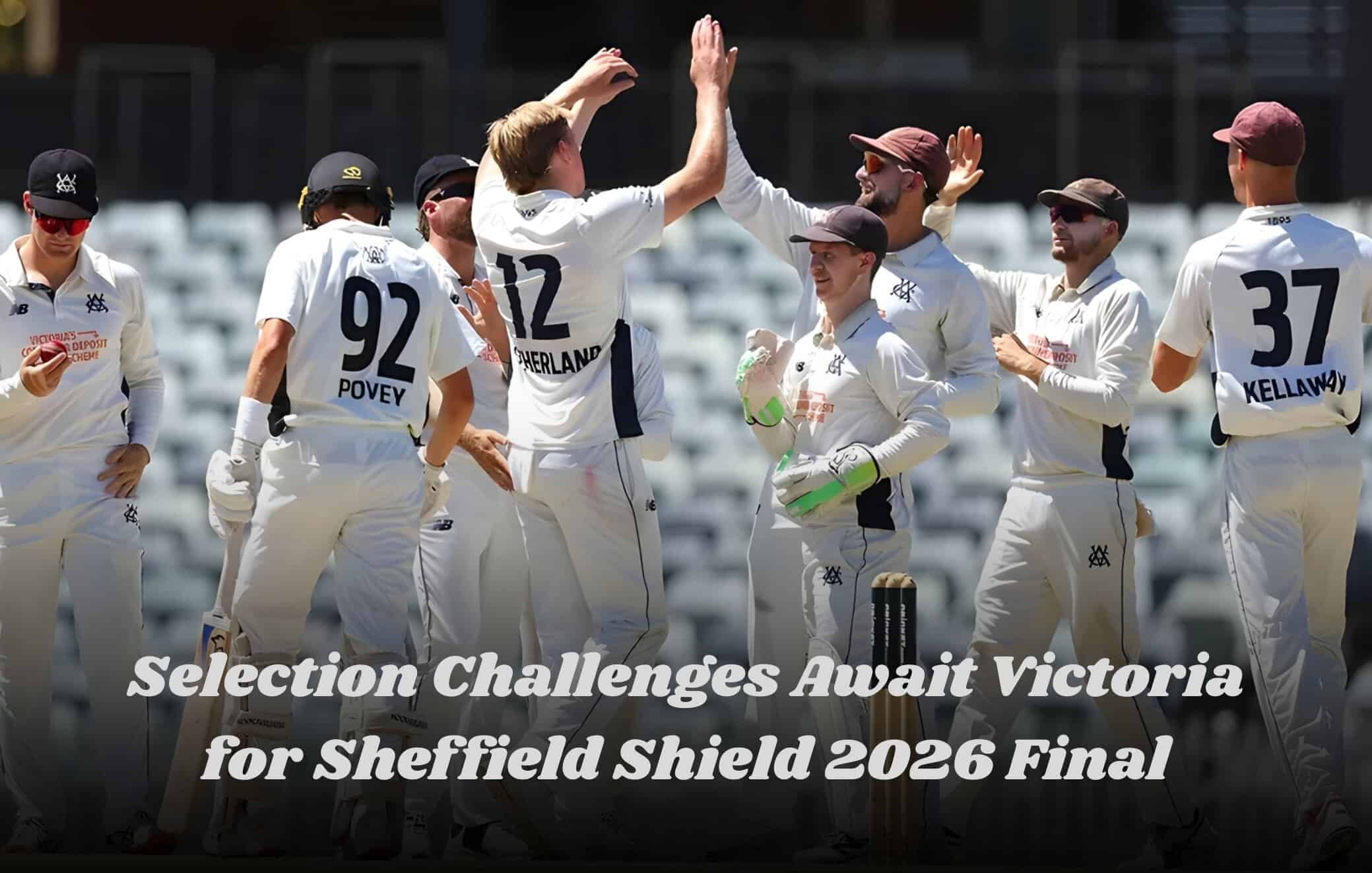
Victoria is confronting a challenging selection scenario as it prepares for the Sheffield Shield 2026 final against South Australia. Coach Chris Rogers has confirmed that Fergus O’Neill, rested in the final round against the same opponent, will return, creating a competitive situation for the remaining quick bowlers. Mitch Perry and Sam Elliott are effectively competing for the final spot in the playing XI.
Both have been pivotal in Victoria’s campaign, producing consistently strong performances. With O’Neill’s place effectively guaranteed, selectors must weigh the fine margins separating Perry and Elliott.
Perry has captured thirty-two wickets across eight matches while Elliott has taken thirty-three in seven outings. The statistics reflect remarkable parity, making the final decision particularly difficult. The context of the Sheffield Shield 2026 final magnifies every selection choice, as Junction Oval conditions and home advantage could prove decisive.
Victoria finished the regular season more than sixteen points clear at the top, granting them a platform to leverage strategic bowling rotations and exploit local conditions.
Statistical Edge: Perry or Elliott in Sheffield Shield 2026?
A deep dive into player statistics provides insight into Victoria’s dilemma. Sam Elliott averaged seventeen point eighteen runs per wicket and delivered a strike rate of thirty-four point thirty-nine. He also boasts three five-wicket hauls this season, demonstrating his ability to dominate innings when in rhythm. Mitch Perry averaged twenty-one point seventy-five with a strike rate of forty-three point forty-three and recorded two five-wicket hauls. Both bowlers have proven capable of delivering under pressure, making Victoria’s final decision a matter of form, fitness, and tactical fit rather than clear performance superiority.
Recent matches provide additional context. In the final round against South Australia, both Perry and Elliott bowled extensively without taking decisive wickets. Elliott took two wickets for fifty-three runs in fifteen overs during the first innings, while Perry returned one for fifty-eight in eighteen overs. In the second innings, Elliott’s economy was impressive at two point one, including five maidens over ten overs, whereas Perry conceded forty-one runs from nine overs at an economy rate of four point fifty-six. The Sheffield Shield 2026 final will require selectors to consider not only statistics but also stamina, adaptability, and suitability to Junction Oval conditions.
Emerging Players Could Shift the Sheffield Shield 2026 Equation
Victoria is also monitoring the condition of emerging batter Dylan Brasher. He sustained a head impact while fielding at short leg during the final round but was cleared to continue. Cricket Australia’s mandatory twelve-day stand-down period for potential concussions could influence his availability for the Sheffield Shield 2026 final. Integrating younger players like Brasher alongside experienced performers such as Will Sutherland and Test star Scott Boland is critical for maintaining squad balance. Selectors must weigh tactical requirements, match conditions, and player fitness in every decision to optimize performance for the final.
The Sheffield Shield 2026 final is shaping up as a contest where every role will matter. Victoria’s coaching staff must identify the ideal mix of pace and spin to exploit Junction Oval’s pitch characteristics. Perry and Elliott bring complementary skills with pace and accuracy, yet the coaching team must ensure the selected bowler can maintain pressure across extended spells in a high-stakes environment.
South Australia Also Faces Selection Headaches in Sheffield Shield 2026
South Australia is dealing with its own set of selection concerns ahead of the Shield final. Test-capped pacer Brendan Doggett is unlikely to be fit in time due to a hamstring issue, limiting fast-bowling options. Wes Agar is under consideration after a back injury, with final decisions contingent on fitness assessments in club matches. South Australia is also evaluating the inclusion of leg-spinner Lloyd Pope, who has taken eleven wickets in four Shield matches this season, including five against Victoria in the opening round. Pope could provide a crucial spin option, particularly if overcast conditions affect the pitch at Junction Oval.
The Sheffield Shield 2026 final is therefore expected to be a tactical chess match, where both sides must carefully balance experience, youth, pace, and spin. Player form, injury management, and the ability to handle high-pressure scenarios will play decisive roles in shaping the final XI for both Victoria and South Australia.
Tactical Outlook for the Sheffield Shield 2026 Final
Victoria’s staff will focus on creating the best combination of pace and spin to leverage home advantage. Perry and Elliott offer different strengths: Perry’s pace and bounce can unsettle batters early, while Elliott’s accuracy and ability to maintain consistent lines can build pressure over long spells. The coaching team must also account for match-ups against South Australia’s top-order batters and the potential impact of emerging talents like Pope.
South Australia faces a balancing act of its own, weighing the inclusion of potentially untested players against maintaining a core of experienced performers. The Sheffield Shield 2026 final promises intense strategic decisions, as subtle variations in squad composition could have significant consequences in a high-stakes match.
Key Player Form Heading into Sheffield Shield 2026 Final
Victoria’s campaign in the Sheffield Shield 2026 has been defined by consistent contributions from both established stars and emerging talents. Will Sutherland’s all-round performances have provided balance, combining crucial wickets with effective middle-order runs. Scott Boland’s experience at the top of the bowling attack gives Victoria the stability to build pressure from the outset. Meanwhile, Perry and Elliott’s form this season makes the selection decision exceptionally nuanced. Both have demonstrated the ability to dominate in favorable conditions, but the final requires players who can deliver under intense pressure.
Emerging batter Dylan Brasher has also impressed with his adaptability and composure in high-stakes matches. If cleared for selection, his inclusion could provide flexibility in the batting order, allowing Victoria to rotate their middle-order positions strategically. The Sheffield Shield 2026 final is a platform where these players’ season-long development is tested, and every contribution can tilt the match in Victoria’s favor.
Probable XI Scenarios for Sheffield Shield 2026
Victoria’s likely playing XI for the Sheffield Shield 2026 final will revolve around the balance between pace, spin, and batting depth. Fergus O’Neill’s return strengthens the fast-bowling options, leaving selectors to choose between Mitch Perry and Sam Elliott. Perry’s ability to generate bounce and maintain sustained pressure makes him suited for exploiting early overs at Junction Oval. Elliott’s control, accuracy, and proven five-wicket hauls offer reliability across longer spells.
In the batting order, the combination of seasoned players and emerging talent is critical. Will Sutherland, along with Dylan Brasher if fit, adds depth and flexibility. Middle-order stability provided by key contributors ensures that Victoria can accelerate scoring in the latter stages while maintaining the capacity to absorb pressure during critical periods. The Sheffield Shield 2026 final will likely see these decisions tested immediately, as match conditions and the opposition’s tactics require adaptability from the outset.
Tactical Strategies Shaping the Sheffield Shield 2026 Final
Victoria’s coaching staff is likely to emphasize exploiting pitch conditions at Junction Oval. Early spells by the pace bowlers will aim to capitalize on bounce and movement, creating opportunities for breakthroughs in the first innings. Spin options, while less prominent than pace in these conditions, will be deployed strategically to control scoring rates and build pressure during middle overs. Perry’s pace and bounce, Elliott’s precision, and Boland’s consistency collectively give Victoria multiple avenues to apply pressure across different phases of the game.
South Australia will likely counter with a combination of pace, spin, and tactical batting. Lloyd Pope’s leg-spin could exploit any cracks in the pitch or overcast conditions, while the batting order must adapt to Victoria’s bowling strengths. The Sheffield Shield 2026 final is expected to hinge on the effectiveness of both teams’ opening bowlers in setting the tone, as well as their ability to adapt dynamically during middle overs and capitalize on scoring opportunities.
Fitness and Injury Management Critical for Sheffield Shield 2026
Fitness considerations are central to selection and strategy. Dylan Brasher’s recent head impact is under close monitoring, and Cricket Australia’s mandatory twelve-day concussion protocol will dictate his availability. The management must also account for the physical demands on key bowlers such as Perry, Elliott, and Boland, particularly in a high-stakes final where extended spells and back-to-back matches test endurance. Strategic rotation and workload management are essential to maintain intensity while minimizing the risk of injury, highlighting how off-field planning is as critical as on-field execution in Sheffield Shield 2026.
Psychological Edge and Match Pressure
The Sheffield Shield 2026 final is not only a test of skill but also of mental resilience. The returning Fergus O’Neill brings confidence from rest and preparation, while Perry and Elliott will contend with the pressure of proving their value in the last XI. Emerging players like Brasher may face added scrutiny, making composure under pressure a key determinant of success. Coaches and support staff must ensure that players remain mentally sharp, focused, and prepared for the ebb and flow of a tightly contested final.
The psychological aspect extends to South Australia as well. Injuries and uncertain selections require players to adapt quickly to evolving conditions and strategies. Both sides will likely rely on leadership from senior players to maintain morale, manage momentum shifts, and reinforce tactical plans throughout the contest.
Expected Match Impact of Selection Decisions
The outcome of the Sheffield Shield 2026 final could hinge on seemingly minor selection choices. Choosing between Perry and Elliott may determine how quickly Victoria can take early wickets and control the innings. The availability of emerging talent like Brasher could influence batting flexibility and scoring rates. South Australia’s fitness and selection decisions, including the inclusion of Lloyd Pope or the fitness of Brendan Doggett and Wes Agar, will similarly shape the contest. Each decision carries tactical implications, from opening overs to closing spells, and will likely influence the overall flow and outcome of the match.
Conclusion: The Stakes and Implications of Sheffield Shield 2026
The Sheffield Shield 2026 final represents the culmination of a season-long battle for Victoria and South Australia. Selection decisions, fitness management, tactical execution, and mental resilience will collectively determine the outcome. For Victoria, the choice between Perry and Elliott, the integration of Fergus O’Neill, and monitoring Dylan Brasher’s fitness highlight the delicate balancing act required to optimize the team for final success. South Australia must also navigate injuries and squad depth considerations while deploying a strategy to counter Victoria’s strengths.
Ultimately, the Sheffield Shield 2026 final is expected to be a contest where preparation meets execution. Victoria’s ability to balance pace and spin, integrate emerging talent with experience, and apply tactical acumen under pressure will be crucial. South Australia’s strategic response to pitch conditions, selection decisions, and injury management will equally influence match dynamics.
The result of this high-stakes final will hinge on marginal gains, with every run, wicket, and tactical choice magnified by the significance of the occasion. Both sides have demonstrated consistent quality throughout the season, but it is the fine details of selection, fitness, and mental preparedness that are likely to determine which team lifts the Shield and cements its place at the top of Australian domestic cricket for the Sheffield Shield 2026 season.
Key Batting Battles in Sheffield Shield 2026
The Sheffield Shield 2026 final is expected to hinge on pivotal batting performances. Victoria’s middle-order stability is anchored by players such as Will Sutherland and Dylan Brasher, who must provide both defensive resilience and scoring impetus. The team’s ability to rotate strike effectively, exploit gaps, and maintain partnerships will be critical against South Australia’s disciplined bowling attack. South Australia, meanwhile, will rely on their top-order batters to set a strong foundation and handle early pressure from Victoria’s pace bowlers.
Analysis of previous Sheffield Shield 2026 encounters shows that Victoria tends to perform best when their batters build long innings, turning starts into meaningful totals. The ability to convert half-centuries into match-defining scores could dictate momentum. Similarly, South Australia’s batters will need to manage overcast conditions and pace movement at Junction Oval, demonstrating adaptability and focus. The interplay between tactical shot selection, patience, and aggressive scoring during power phases will determine which side asserts control in the opening sessions of the final.
Bowling Strategies That Could Decide Sheffield Shield 2026
Victoria’s pace attack is central to their Sheffield Shield 2026 final strategy. The choice between Mitch Perry and Sam Elliott will define the team’s approach to opening spells and sustained pressure across innings. Fergus O’Neill’s return adds a potent option for early breakthroughs, while Scott Boland’s experience provides control in middle overs. Spin options will complement the pace attack by limiting scoring opportunities and enticing batters into mistakes, creating wicket-taking chances in crucial periods.
South Australia will balance pace and spin based on pitch conditions, relying on Lloyd Pope to exploit turning deliveries and maintain pressure during middle overs. The selection of Agar or Doggett, if fit, will add further depth to their pace attack. Both teams’ bowling strategies are expected to focus on maintaining consistency, targeting key batters, and capitalizing on home or away conditions. In Sheffield Shield 2026 finals, subtle tactical decisions regarding bowling rotation, field placement, and line consistency often dictate which team gains the upper hand in tight matches.
Mental Toughness and Leadership in Sheffield Shield 2026
Leadership and mental resilience will play a decisive role in Sheffield Shield 2026. Victoria’s senior players are tasked with guiding emerging talent while maintaining composure under high-pressure circumstances. The psychological ability to manage setbacks, adapt to changing conditions, and motivate teammates will complement technical skill. Mental toughness, particularly in handling late-session pressure and tight scoring scenarios, is often the differentiator in finals.
South Australia faces similar challenges. Captains and senior bowlers must lead by example, ensuring that inexperienced players respond effectively to setbacks. The Sheffield Shield 2026 final will test concentration, strategic decision-making, and teamwork. Leaders on both sides will need to communicate effectively, rotate players to manage fatigue, and maintain focus throughout the match. The outcome will not only reflect talent but also the ability of each team to execute plans while managing the psychological intensity unique to a domestic final.
Final Thoughts on Sheffield Shield 2026
The Sheffield Shield 2026 final is poised to be a definitive test of skill, strategy, and mental resilience for both Victoria and South Australia. Every selection choice, from the debate between Mitch Perry and Sam Elliott to the integration of emerging talents like Dylan Brasher, carries significant tactical implications. Victoria’s ability to balance pace, spin, and batting depth will be critical in exploiting Junction Oval conditions, while South Australia must carefully navigate injuries and squad rotation to remain competitive. The season-long performances of both teams highlight their strengths, but the fine margins of a final often emphasize the importance of adaptability, leadership, and composure under pressure.
Beyond statistics, the Sheffield Shield 2026 final will demonstrate the value of mental toughness and strategic preparation. Experienced players such as Will Sutherland, Scott Boland, and Fergus O’Neill are tasked with guiding less seasoned teammates while maintaining focus in high-stakes scenarios. The psychological component, including handling momentum shifts, sustaining energy across long innings, and responding to pivotal moments, will be just as crucial as technical execution. Every decision in the field, every tactical adjustment, and every calculated risk has the potential to determine the match’s outcome.
Ultimately, Sheffield Shield 2026 is more than a contest of runs and wickets. It is a showcase of domestic cricket excellence, where player development, coaching strategy, and adaptability converge in a high-pressure environment. The final promises to test the resilience, depth, and versatility of both squads. Victoria’s strategic selections, South Australia’s countermeasures, and the individual brilliance of key performers will combine to produce a gripping conclusion to the season. For cricket followers and analysts alike, Sheffield Shield 2026 represents a rich narrative of competition, talent, and the drama that defines Australian domestic cricket.
🔗 Visit our other platforms:
8jjSports.com