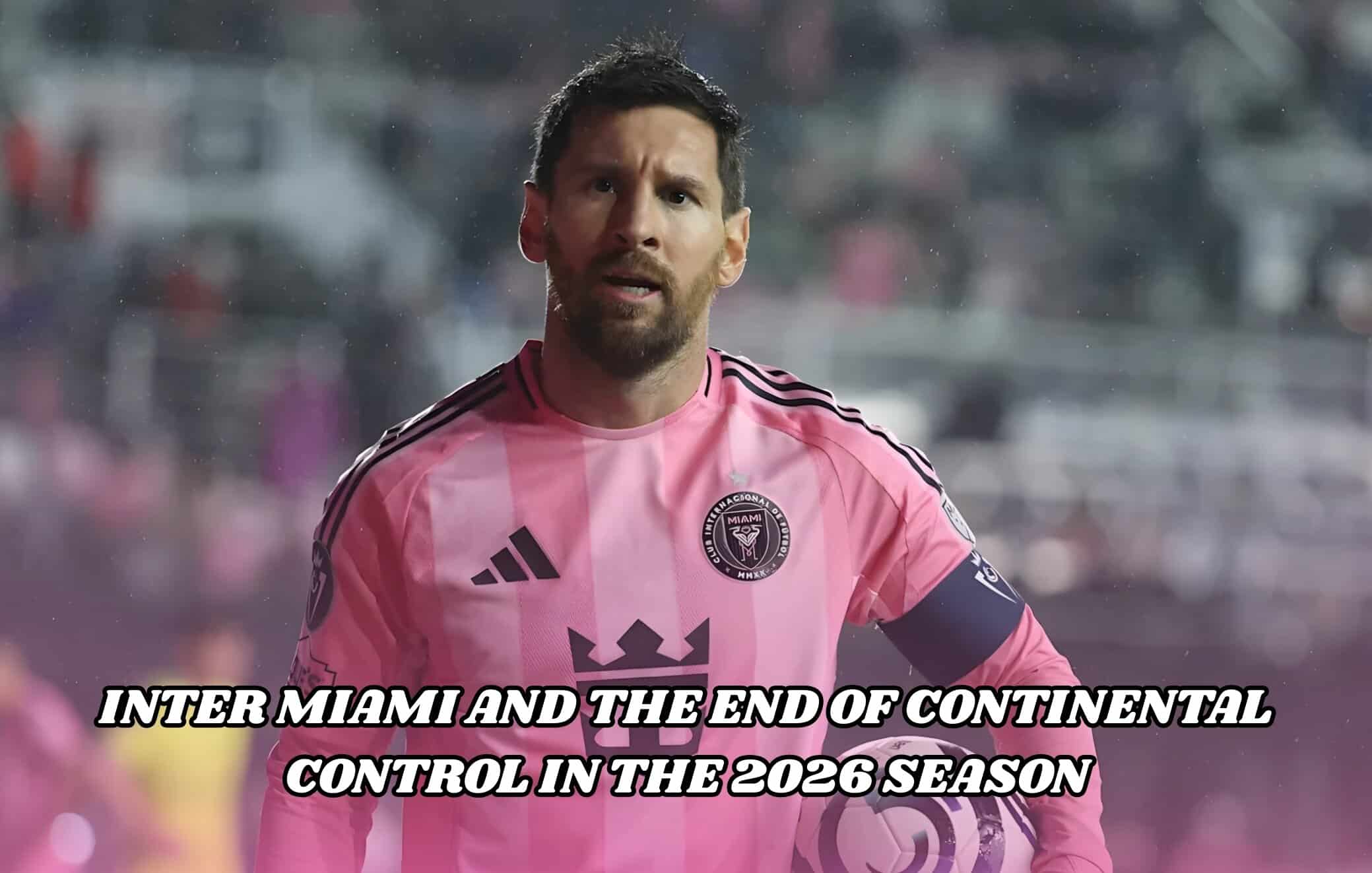
Inter Miami Champions Cup exit and what it really means in 2026
The 2026 season for Inter Miami CF has already delivered a major turning point with their exit from the Concacaf Champions Cup. The defeat to Nashville SC did more than end their run in the competition. It exposed how fragile control can become when a team is still rebuilding parts of its structure while competing at the highest level.
In knockout football, small gaps become big problems very quickly. Over two legs, teams do not just need quality. They need stability, control, and the ability to manage pressure across different game states. Inter Miami showed moments of quality, but they struggled to keep that control consistent across the full tie.
This is why the result feels important. It is not just about one bad performance. It is about how the team is currently built and how that structure holds up when the pressure increases.
Lionel Messi remains the centre of everything Inter Miami do
Even in defeat, Lionel Messi remains the key figure in every Inter Miami performance. His influence is still huge in 2026. He continues to decide games, create chances, and produce moments that most players simply cannot replicate.
In this Champions Cup tie, Lionel Messi still delivered a major milestone by scoring his 900th career goal. That alone shows his level has not dropped, even in a demanding knockout environment. But football is rarely decided by one player, no matter how great he is.
The problem for Inter Miami is not Lionel Messi’s performance. The issue is how much the team depends on him when games become tight and structured. In knockout matches, opponents can focus their entire defensive plan around limiting one player’s influence. When that happens, the rest of the system must take over. That is where Inter Miami struggled.
Messi is still producing moments of brilliance, but the overall attacking flow becomes harder to maintain when the supporting structure cannot consistently match his output.
Nashville SC showed how organised teams can control Inter Miami
A big part of this story is how Nashville SC approached the tie. They did not try to outplay Inter Miami through individual talent. Instead, they focused on organisation, discipline, and structure over both legs.
Their defensive shape stayed compact, especially in central areas where Inter Miami usually try to build attacks. This forced Miami to play wider and slower, which reduced their ability to create quick combinations near the box.
Nashville also managed transitions very well. Whenever Inter Miami tried to push forward, Nashville were quick to close space and reset their defensive lines. This made it difficult for Miami to build long attacking sequences.
What this shows is a clear trend in MLS and Concacaf football. Teams are becoming more tactically disciplined. You cannot rely only on star power anymore. Structured teams can now compete directly with star-driven sides and often control key moments in knockout games.
Squad changes are affecting Inter Miami’s balance
Another major factor in this Champions Cup exit is the ongoing squad transition at Inter Miami. The team has gone through important changes in recent transfer windows, and those changes are still shaping how they play in 2026.
The departures of experienced players like Sergio Busquets and Jordi Alba have had a clear impact on how the team controls matches. These players were not just experienced names. They were important tactical anchors.
Busquets, in particular, helped control the rhythm of games from midfield. He slowed things down when needed, kept possession stable, and helped the team stay organised under pressure. Without him, Inter Miami can feel less controlled in tight matches.
Jordi Alba also played a key role in linking defence and attack. His movement helped stretch the pitch and support forward play, especially in transition moments.
Without these players, Inter Miami are still adjusting. That adjustment is happening while they are competing in big matches, which makes consistency harder to achieve.
Why knockout football exposes Inter Miami’s current weaknesses
The Champions Cup format does not give teams much room for mistakes. Over two legs, every weak point gets tested repeatedly. That is exactly what happened to Inter Miami.
They still have attacking quality. They still have match winners. But in knockout football, you also need control during quiet phases of the game. You need to manage tempo, protect leads, and stay organised when you are not in control of possession.
Inter Miami struggled most when they had to slow the game down or regain control after pressure from Nashville. In those moments, the structure around Messi did not always provide enough support to keep attacks flowing or relieve pressure.
This led to a pattern where Inter Miami could create chances, but not consistently control the rhythm of the match across both legs.
A team in transition, not a team in collapse
Even though the Champions Cup exit is a setback, it does not define Inter Miami’s entire season. The team is still in a transition phase. They are adapting to squad changes, adjusting tactical roles, and building a new structure around their key players.
The presence of Messi means Inter Miami always have a chance in any match. But football at this level is increasingly about systems as much as individuals. The strongest teams are the ones that combine both.
Right now, Inter Miami are still finding that balance. Some parts of the system are working well, especially in attack. Other parts, particularly in midfield control and match management, are still developing.
That gap is what showed up in the Champions Cup. And until it closes, results in high-level knockout football will continue to swing based on how well the structure holds together under pressure.
How Inter Miami builds everything around Lionel Messi in 2026
In the 2026 season, the entire attacking identity of Inter Miami CF continues to revolve around Lionel Messi. Even as the squad evolves and new tactical ideas are introduced, Messi remains the main reference point for every attacking phase of the team.
This is not just about star power. It is about structure. Inter Miami build their attacks in a way that constantly tries to put Messi in positions where he can decide the game. That means more touches between the lines, more involvement in central attacking zones, and more responsibility in the final pass or final shot.
The challenge in 2026 is that this structure is being tested more aggressively than before. Opponents now prepare specifically to reduce Messi’s influence, which forces Inter Miami to find alternative routes to goal creation. When those alternatives do not function consistently, the attacking system becomes heavily concentrated around one player.
That is where both the strength and the risk of this model becomes visible.
Messi’s influence is still elite, but the burden keeps growing
Even in a season of transition, Messi’s output remains exceptional. He still creates chances that change matches instantly. He still finds space that other players do not see. And he still produces decisive moments even in tightly controlled knockout environments.
The issue is not performance. The issue is load.
In the Champions Cup tie against Nashville SC, Messi once again showed his ability to deliver in key moments, including scoring his landmark 900th career goal. But the match also showed how often Inter Miami depend on him to solve situations that should ideally be handled by the wider attacking unit.
When Messi is forced to drop deeper to collect the ball, he becomes more involved in build-up play rather than finishing attacks. When he is tightly marked near the final third, Inter Miami lose some of their natural creativity unless other players step forward consistently.
This creates a pattern where Messi is not only the team’s main attacking weapon, but also the main connector between midfield and attack. That dual responsibility is effective in short bursts, but it becomes harder to sustain over two legs of a knockout tie.
How attacking transitions become predictable when structure is missing
One of the biggest tactical problems in Inter Miami’s 2026 system is how their transitions into attack behave under pressure. When the team wins the ball, the natural instinct is to find Messi quickly. That is understandable, but it also makes the attacking pattern easier to read.
Nashville SC used this to their advantage in the Champions Cup tie. They stayed compact in central areas and reduced the space Messi had to turn or receive the ball facing forward. This forced Inter Miami to circulate possession wider and slower.
Once that happened, Inter Miami struggled to consistently re-accelerate attacks. Without quick vertical progression, attacks became more predictable and easier to defend against. Nashville were then able to reset their shape and control defensive spacing more effectively.
This is where Messi’s brilliance still shines, but also where system support becomes crucial. When the structure around him is sharp, he can break games open. When it is not, he is forced into deeper positions where his influence becomes harder to translate into direct attacking output.
The role of missing midfield structure in limiting attacking flow
A major reason for this imbalance comes from midfield transition changes within the squad. The departures of experienced control players such as Sergio Busquets and Jordi Alba continue to affect how Inter Miami manage possession phases.
Busquets was particularly important because he controlled tempo. He knew when to slow games down and when to speed them up. That control allowed Messi to stay higher up the pitch more often, conserving energy for decisive moments.
Without that control layer, Inter Miami’s midfield can feel more direct and less structured in possession. That leads to faster transitions, but also less stability when the team needs to reset attacks or manage pressure.
Jordi Alba’s influence also mattered in a different way. His forward runs helped stretch defences and create space for Messi to operate inside. Without that constant width threat, opposition teams can compress central areas more confidently.
Together, these changes affect how often Inter Miami can create clean attacking sequences. It is not that they cannot create chances. It is that the process of creating chances is less controlled than before.
Lionel Messi remains the solution, but also the focal point of opposition planning
As Inter Miami move through the 2026 season, one of the biggest tactical realities is that every opponent now builds a specific plan around stopping Messi’s influence.
That does not mean he is contained completely. It means teams try to reduce the number of moments where he can receive the ball in dangerous central areas. They do this by crowding passing lanes, doubling up in tight spaces, and forcing Inter Miami to rely on wider buildup.
This approach does not eliminate Messi’s impact, but it changes how often he can influence matches directly. It also increases pressure on supporting attackers to convert opportunities when they arise.
For Inter Miami, this creates a constant tactical balance. The more they rely on Messi, the more predictable their attacking structure becomes. But the less they involve him, the less creative their final-third output tends to be.
This is the central tension of their 2026 attacking system.
A high-output attack that still needs structural balance
Despite the issues exposed in the Champions Cup, Inter Miami’s attacking system is still highly dangerous. They can create chances quickly, and they can still break down defences when combinations click at the right time.
The difference in 2026 is consistency. The system works in bursts rather than sustained cycles. That is often enough to win domestic matches, but it becomes more fragile in knockout competitions where control over both legs matters more than individual moments.
Messi remains the key to unlocking any defence. But the team around him is still adjusting to how to maximise his influence without overloading him or making the attack predictable.
That balance is still being developed, and until it stabilises, Inter Miami will continue to fluctuate between dominant attacking phases and stretches where they struggle to maintain control in advanced positions.
Midfield transition and the loss of control rhythm in Inter Miami’s 2026 structure
The 2026 season has exposed a deeper issue inside Inter Miami CF that goes beyond finishing or attacking output. The real shift is happening in midfield, where the team is still trying to rebuild its control identity after major squad changes.
In modern football, midfield control is what determines whether a team can manage games or simply react to them. It is the phase that connects defence and attack, and it is where rhythm is set across 90 minutes. For Inter Miami, this rhythm has become less stable in 2026.
The departure of experienced control players has changed how the team builds possession. Instead of a structured tempo system, Inter Miami now move through phases with more variation and less predictability. That can create attacking freedom, but it also removes the steady control needed in knockout competitions.
This imbalance became clear in the Champions Cup exit against Nashville SC, where Inter Miami struggled to maintain consistent possession under pressure for long periods of the match.
The absence of midfield structure and its impact on Lionel Messi
The midfield transition has a direct impact on Lionel Messi. When midfield control is stable, Messi can operate higher up the pitch and focus on decisive attacking moments. When it is unstable, he is forced deeper into build-up play to help the team progress the ball.
This changes the entire attacking dynamic. Instead of receiving the ball near the final third, Messi often becomes involved earlier in the sequence. That reduces his presence in goal-scoring positions and increases his workload in areas that require constant movement and distribution.
In the Champions Cup tie, this pattern was visible. Messi still created dangerous moments, but he also had to drop deeper more often to help Inter Miami escape pressure phases. That reduces efficiency in knockout matches where every attacking sequence matters.
This is not a decline in Messi’s ability. It is a reflection of how much responsibility shifts onto him when midfield structure is not fully stable.
The impact of Busquets and Alba on game control
A key part of Inter Miami’s midfield stability previously came from experienced players such as Sergio Busquets. His role was not just to pass the ball but to control the pace of the game. He helped Inter Miami slow matches down when needed and reset possession under pressure.
Without him, Inter Miami’s midfield often plays at a more direct rhythm. That can increase attacking speed, but it also reduces control during difficult phases of matches. In knockout football, that control is often what separates teams that survive pressure from those that collapse under it.
Similarly, Jordi Alba played an important role in linking midfield to attack. His forward runs created width and helped stretch opposition defences. That spacing allowed midfielders more passing options and helped Messi find better pockets of space.
Without these two players operating as stabilising influences, Inter Miami’s midfield becomes more exposed when pressed. Opponents can compress central areas more easily, forcing longer possession chains and increasing the risk of turnovers.
Nashville SC and the effectiveness of midfield disruption
The Champions Cup elimination also highlighted how well Nashville SC managed midfield pressure across both legs. Their approach was not about dominating possession but about disrupting Inter Miami’s rhythm at key moments.
They focused on closing central passing lanes and forcing Inter Miami into wider areas where progression is slower and less direct. This reduced the ability of Inter Miami to build stable attacking sequences through the middle.
Once the midfield rhythm was disrupted, Inter Miami found it harder to connect phases smoothly. This created longer gaps between defence and attack, which reduced the frequency of high-quality chances.
This type of control is becoming more common in MLS and Concacaf football. Teams are no longer afraid of possession-heavy sides if they can control midfield spacing and force predictable build-up patterns.
Inter Miami’s transition phase and its effect on consistency
Inter Miami’s current midfield structure is best described as transitional rather than settled. The team is still adapting to new personnel and adjusting how different players fit into the system.
This transition affects consistency more than it affects peak performance. On good days, Inter Miami can still produce high-quality attacking football. But on difficult days, especially against well-organised opponents, the lack of stable midfield control becomes more visible.
This inconsistency is what made the Champions Cup exit so significant. Over two legs, there is less room to hide structural weaknesses. Every phase of the game is repeated, tested, and adjusted by the opposition.
Without a fully stabilised midfield rhythm, Inter Miami are forced into reactive patterns rather than controlled ones. That makes it harder to manage game tempo, especially when leading or trying to recover from setbacks.
Midfield control as the deciding factor in 2026 progression
As the 2026 season continues, midfield stability will likely become the most important factor in determining how far Inter Miami can progress in both domestic and international competitions.
Attackers can decide matches in moments, and Messi continues to provide those moments. But midfield control decides how often those moments appear and how sustainable the team is across long competitions.
For Inter Miami, the challenge is not just rebuilding personnel. It is rebuilding rhythm. Until that rhythm becomes consistent again, performances will continue to fluctuate depending on opposition style and match pressure.
The Champions Cup exit against Nashville SC showed exactly what happens when that rhythm is disrupted across two legs. It becomes difficult to maintain control, difficult to sustain attacks, and difficult to recover momentum once it is lost.
Defensive structure under pressure in Inter Miami’s 2026 reality
The 2026 season has forced Inter Miami CF to confront a defensive reality that becomes most visible in high pressure knockout matches. While the team still carries elite attacking quality through Lionel Messi, the defensive structure has been less consistent when tested over full matches against organised opponents.
The Champions Cup elimination against Nashville SC highlighted this clearly. Inter Miami were not overwhelmed in open play, but they struggled to maintain defensive compactness during sustained phases of pressure. Small gaps between midfield and defence became more exploitable as the match progressed.
In modern knockout football, defensive control is not only about tackles or clearances. It is about spacing, coordination, and how quickly a team resets shape after losing possession. Inter Miami’s structure in 2026 is still adapting to changes in personnel, which has made these transitions less stable than in previous seasons.
The result is a team that can defend well in moments, but struggles to maintain defensive rhythm across long stretches of a match.
Leadership response and tactical adjustment under Ajin and Nayar
Despite the challenges, leadership within Inter Miami has focused on maintaining clarity rather than overcorrecting the system. Under the guidance of captain Lionel Messi and head coach leadership structures involving senior staff, the approach has been to prioritise adaptability over rigid tactical design.
The idea is simple. Instead of forcing a single system, Inter Miami are working with flexible structures that can shift depending on opponent behaviour. This includes adjusting pressing intensity, changing midfield spacing, and rotating attacking responsibilities based on match flow.
However, flexibility only works when the base structure is stable. Without consistent defensive organisation and midfield control, adaptability can sometimes turn into inconsistency. This is one of the main challenges Inter Miami are trying to solve in 2026.
The coaching response has been to simplify decision making during matches. Players are encouraged to focus on core roles rather than overcomplicated tactical adjustments. This is intended to reduce errors during high pressure phases, especially when games become stretched.
The Messi factor in defensive transition phases
Even though Lionel Messi is primarily an attacking player, his influence extends into how Inter Miami defend as a unit. When Messi is positioned higher up the pitch, the team can press more compactly and force opponents into wider build-up channels.
However, when Messi drops deeper to participate in build-up play, the team’s defensive shape changes. The attacking line becomes less aggressive in pressing transitions, which can give opponents more time to progress through midfield zones.
This creates a subtle but important tactical trade-off. Inter Miami gain more control in possession phases when Messi is involved deeper, but they lose some immediate pressure in defensive transition moments.
Balancing this trade-off is one of the key tactical challenges of the 2026 season. It requires coordination from the entire team, not just individual brilliance from Messi.
How Nashville SC exposed structural gaps across two legs
The Champions Cup tie against Nashville SC showed how quickly small defensive gaps can become decisive in knockout football. Nashville did not rely on overwhelming possession. Instead, they focused on timing, spacing, and exploiting transitions when Inter Miami were slightly out of shape.
Their approach was patient. They waited for moments when Inter Miami’s midfield was stretched or when defensive recovery runs were delayed. In those moments, they attacked space quickly and directly.
This exposed a recurring issue for Inter Miami in 2026. When the team loses the ball in advanced areas, the recovery structure is not always fully set. That creates short windows where opponents can attack before Inter Miami reset their defensive shape.
Over two legs, these small moments accumulate. Even if the overall performance is competitive, the lack of defensive consistency in transition becomes decisive.
What this means for Inter Miami’s 2026 identity
The Inter Miami project in 2026 is no longer just about attacking talent or individual brilliance. It is about identity under pressure. The team is trying to evolve from a star driven structure into a more balanced system that can compete consistently in both domestic and continental competitions.
Inter Miami CF still have elite match winners, and Lionel Messi remains the central figure of that identity. But the Champions Cup exit showed that individual brilliance alone is not enough in tightly organised knockout football.
The next stage of development requires defensive stability, midfield control, and clearer transition structures. Without those elements working together, the team will continue to produce strong moments without full match control.
Final perspective on Inter Miami’s 2026 trajectory
The 2026 campaign is shaping into a defining period for Inter Miami. It is a season that tests not just quality, but structure and consistency. The Champions Cup exit against Nashville SC is not simply a setback. It is a tactical reference point that highlights where improvement is needed.
Inter Miami remain a dangerous and high quality side. But their success moving forward depends on how quickly they can stabilise defensive organisation, rebuild midfield rhythm, and support Lionel Messi with a system that reduces overload rather than increasing it.
If those adjustments are made effectively, the team can still achieve a strong 2026 season. If not, they risk repeating the same pattern of brilliance in moments but inconsistency across competitions.
🔗 Visit our other platforms:
8jjSports.com