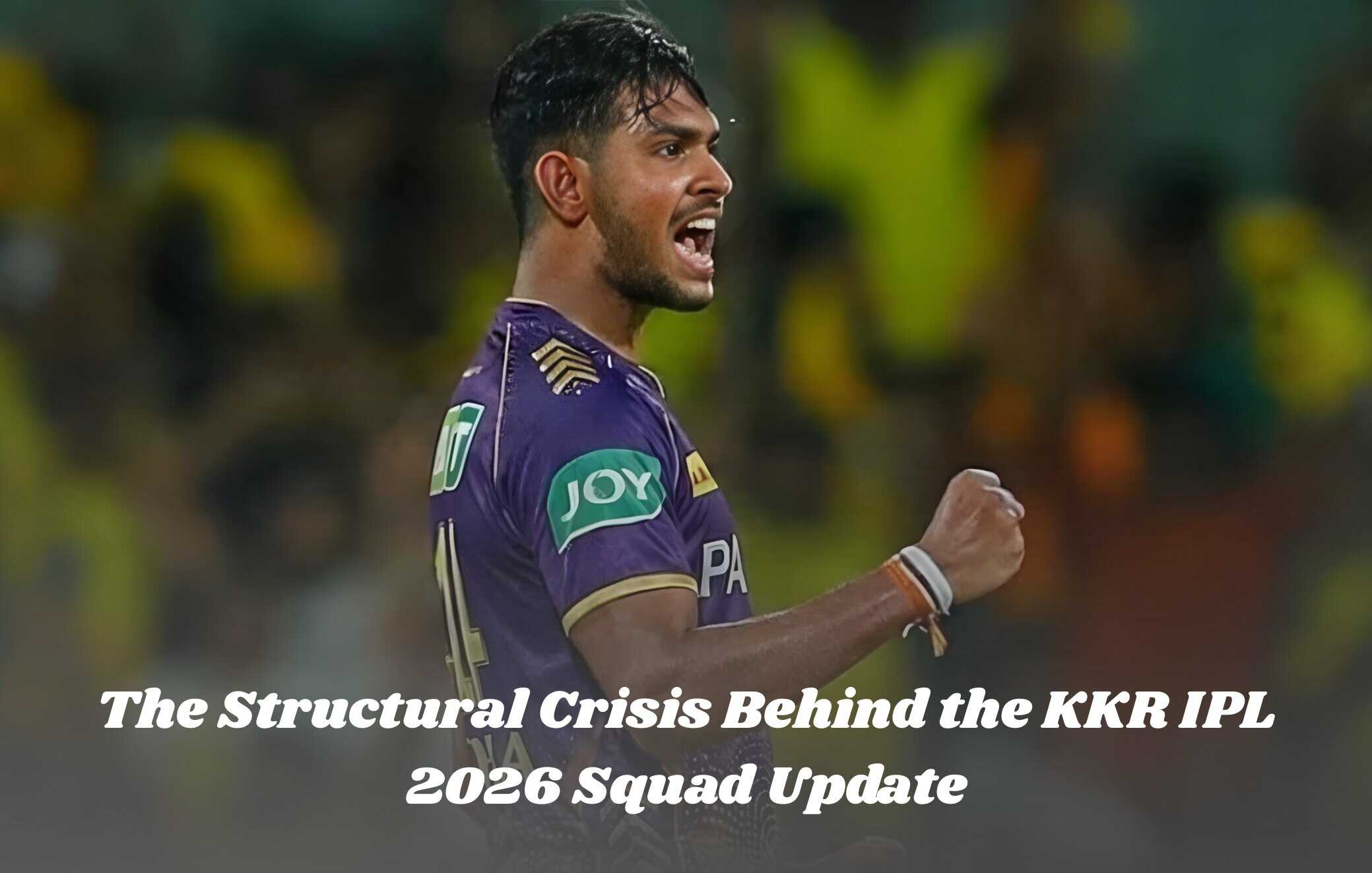
The structural instability defining IPL 2026 before the season begins
The IPL 2026 campaign for Kolkata Knight Riders begins with an unusual and strategically significant imbalance already embedded within its bowling architecture. Unlike typical pre-season uncertainty, which usually revolves around form, rotation, or tactical refinement, the situation here is structural. It is not about whether the bowling unit will perform, but whether the bowling unit as originally designed can actually exist in its intended configuration when the tournament begins.
In modern IPL cycles, bowling systems are no longer built as flexible collections of interchangeable bowlers. They are engineered as phase-specific execution frameworks, where each component is assigned a defined functional responsibility across powerplay, middle overs, and death overs. In IPL 2026 conditions, where batting aggression continues to escalate across franchises, bowling systems must be stable enough to absorb pressure waves while still maintaining wicket-taking capacity across all phases.
KKR’s model was originally designed with that logic in mind, but it now faces a pre-season breakdown in its most sensitive layer: the high-pressure execution phase at the end of innings. This phase, more than any other, defines modern T20 outcomes, and its instability has cascading effects on the rest of the bowling structure.
What makes IPL 2026 particularly unforgiving is that tactical misalignment cannot be gradually corrected over time. The compressed scheduling of the tournament forces immediate adaptation. Any pre-existing structural weakness is therefore magnified rather than stabilised once competitive play begins.
Death overs dependency and the removal of system certainty in IPL 2026
At the core of KKR’s IPL 2026 bowling blueprint was a clearly defined specialist role system designed to handle the final overs of innings, where scoring rates typically accelerate beyond controllable thresholds unless precise execution is maintained. This was not simply about selecting a strike bowler; it was about creating a repeatable containment mechanism that could function under conditions of maximum batting pressure.
The intended anchor of this phase was Matheesha Pathirana, whose role in IPL 2026 planning was not peripheral but central to the entire structural model. For Matheesha Pathirana, the expectation was to function as a high-pressure terminal bowler capable of restricting boundary progression during the most volatile phase of the innings.
In elite T20 systems, a death overs specialist is not just a bowler who delivers the final overs; they are a stabilising mechanism that allows the rest of the bowling unit to operate without overcompensating for end-phase leakage. When that mechanism is compromised, the entire system begins to shift its internal load distribution, forcing earlier overs to absorb tactical pressure originally reserved for the final phase.
Pathirana’s injury uncertainty introduces exactly this type of systemic distortion. The issue is not simply absence of availability, but absence of predictability. Without certainty around his role, KKR cannot pre-allocate overs, cannot structure phase-based bowling rotations, and cannot build defensive fielding structures tailored to end-overs execution patterns.
This creates a ripple effect that extends beyond one player. It forces a redefinition of the entire bowling identity in IPL 2026, shifting it from a specialist-driven architecture to a distributed responsibility model. While distributed models can work in T20 cricket, they require higher coordination precision and significantly increase tactical variability under pressure conditions.
Domestic fast-bowling erosion and the collapse of rotational stability in IPL 2026
The instability in IPL 2026 is not confined to overseas execution roles. It extends into the domestic fast-bowling framework, where rotational stability is typically maintained to ensure continuity across match phases. Domestic pace bowlers often serve as the connective tissue between specialist overseas bowlers and spin-heavy middle overs strategies.
For Harshit Rana, the intended role in IPL 2026 was structurally important rather than headline-driven. He was expected to function as a transitional bowler capable of operating across multiple phases, particularly in scenarios where workload distribution needed to be balanced without overexposing specialist bowlers.
His injury-induced unavailability removes a key structural buffer within the bowling rotation system. In high-level T20 planning, buffer roles are often undervalued in public analysis but are critical in maintaining internal stability. They allow teams to absorb unexpected match developments without forcing tactical overreaction.
Without this buffer layer, KKR’s bowling unit becomes more rigid and less adaptable. Overs that were previously interchangeable must now be allocated with greater precision, reducing flexibility in response to in-game momentum shifts. This increases reliance on overseas bowlers, which in turn amplifies pressure on already unstable components of the system.
This creates a structural imbalance where workload concentration becomes unavoidable rather than strategic. In IPL 2026 conditions, such concentration increases injury risk, reduces tactical unpredictability, and limits the captain’s ability to adjust matchups dynamically.
Loss of variation profiles and narrowing of tactical unpredictability in IPL 2026
A further destabilising factor in IPL 2026 is the removal of variation-based bowling profiles that were originally intended to disrupt batting rhythm during middle overs. In modern T20 cricket, variation is not simply about spin or pace changes; it is about disrupting predictive batting models that are built on sequencing and tempo control.
The absence of Mustafizur Rahman from the setup removes a specific type of variation that was designed to interrupt batting flow patterns through angle changes and slower-ball deception. For Mustafizur Rahman, his tactical value in IPL 2026 would have extended beyond wicket-taking into rhythm disruption, particularly in overs where batters attempt to consolidate before late acceleration.
Without this profile, KKR’s bowling attack becomes more linear in its execution structure. Linear attacks can still succeed, but they rely heavily on execution precision rather than disruption-based advantages. This increases vulnerability in high-scoring conditions, where batters are increasingly trained to adapt quickly to standard bowling patterns.
The absence of variation layers also reduces the team’s ability to reset innings momentum after aggressive powerplay phases. In IPL 2026, where powerplay scoring rates continue to rise, middle overs control is becoming increasingly important as a stabilisation phase. Without variation-driven disruption, this stabilisation becomes more difficult to achieve consistently.
As a result, KKR’s bowling identity shifts further toward predictability, which in elite T20 environments is one of the most structurally limiting characteristics a team can carry into a tournament.
Systemic transition from planned architecture to reactive construction in IPL 2026
The combined effect of these disruptions is not isolated weakness but systemic transition. KKR are no longer entering IPL 2026 with a fully defined bowling architecture. Instead, they are entering with a partially dismantled framework that must be reconstructed through live competitive conditions rather than pre-season optimisation.
This transition is significant because IPL preparation cycles are designed to refine existing systems, not rebuild them. When foundational elements such as death overs structure, domestic rotation stability, and variation profiles are simultaneously destabilised, the team is forced into a reactive construction model.
In this model, tactical decisions are no longer pre-encoded into match planning. They must be made dynamically based on available personnel, opposition behaviour, and in-game conditions. While elite teams can operate in this mode, it requires high coordination intelligence and significantly increases cognitive load on leadership structures.
This is particularly important in IPL 2026 because early matches act as calibration environments. Any misalignment in the opening phase of the tournament does not remain isolated; it compounds through scheduling pressure and reduces recovery time for structural correction.
At this stage, KKR are not just managing injury uncertainty. They are managing a structural redesign process that must occur under competitive pressure rather than controlled preparation conditions.
The tactical reallocation crisis shaping IPL 2026 execution patterns
The IPL 2026 season places Kolkata Knight Riders into a tactical environment where the traditional segmentation of bowling phases is no longer operating under stable assumptions. In modern T20 cricket, phase control is not simply a descriptive breakdown of overs but a structural system that determines how pressure is absorbed, redistributed, and converted into wicket-taking opportunities across the innings.
For IPL 2026, KKR’s challenge is not limited to personnel uncertainty but extends into the reallocation of responsibilities across the powerplay, middle overs, and death overs in real time. This reallocation is not a minor adjustment; it represents a full redesign of how the team understands tempo control across 20 overs of cricket.
In elite IPL environments, phase control systems depend on predictable role execution. Each bowler is assigned a specific functional identity tied to overs, matchups, and expected pressure conditions. However, when those identities become unstable, the entire structural rhythm of the innings becomes reactive rather than pre-planned.
This is where IPL 2026 becomes particularly complex for KKR. Instead of executing a refined system, they are forced to operate within a constantly shifting allocation model where bowling roles must be reassigned based on availability rather than tactical optimisation.
Powerplay instability and early-innings control degradation in IPL 2026
The powerplay phase in IPL 2026 is increasingly defined by aggressive batting intent, where opening partnerships are designed to extract maximum value from fielding restrictions. In this environment, early overs are no longer about containment alone; they are about preventing momentum establishment that carries into the middle overs.
For KKR, the powerplay structure is indirectly destabilised by the absence of a consistent fast-bowling hierarchy. Without a clearly defined opening combination that can reliably operate under high-intensity conditions, the team loses the ability to enforce early control patterns that dictate innings trajectory.
In structured bowling systems, the powerplay is not just an isolated phase but a foundation layer that determines how middle overs will be played. When early overs fail to establish control, middle overs become reactive containment zones rather than proactive pressure phases.
The IPL 2026 challenge for KKR is that their powerplay options now lack clear sequencing logic. Without stable availability across their fast-bowling group, the captain is forced to adjust combinations based on match-day conditions rather than pre-planned tactical mapping.
This introduces variability in early innings outcomes, which in turn increases pressure on middle overs operators to recover control that was not established in the opening phase.
Middle overs compression and the loss of structural breathing space in IPL 2026
The middle overs phase in IPL 2026 represents the most structurally sensitive portion of the innings because it acts as the transition bridge between containment and acceleration. For KKR, this phase is now under increased pressure due to instability in both the powerplay and death overs structures.
Without early control, middle overs bowlers are forced into defensive execution patterns rather than attacking containment strategies. This shifts the psychological and tactical balance of the innings, as bowlers must now operate under conditions of accumulated pressure rather than controlled progression.
The absence of variation-driven disruption further compounds this issue. Without bowlers capable of breaking batting rhythm through non-linear deliveries or angle manipulation, the middle overs become more predictable, allowing opposition batters to structure innings progression with greater confidence.
For Mustafizur Rahman, the intended role in IPL 2026 planning would have been particularly relevant in this phase. His style of bowling is designed to interrupt set batter rhythm cycles, forcing recalibration of scoring intent. Without this component, KKR’s middle overs lose a key disruption layer.
The result is a compression effect, where middle overs no longer function as a stabilising phase but instead become an extension of either powerplay pressure or death overs preparation. This reduces tactical breathing space, forcing earlier decision-making under uncertainty.
Death overs redistribution and the collapse of final-phase certainty in IPL 2026
The most significant structural disruption in IPL 2026 for KKR remains the death overs phase, where tactical certainty has been replaced by rotational experimentation. In modern T20 systems, death overs are the most specialised phase of the innings, requiring precise execution under extreme pressure conditions.
For Matheesha Pathirana, the intended role was to anchor this phase with a repeatable execution model capable of absorbing boundary pressure while maintaining wicket-taking potential. His absence or uncertainty forces KKR to redistribute this responsibility across multiple bowlers who may not share the same specialist profile.
This redistribution is not simply a change in personnel; it is a structural redesign of how final overs are managed. Instead of relying on a single execution anchor, KKR must now experiment with hybrid combinations that attempt to replicate specialist output through collective effort.
In IPL 2026 conditions, this introduces a high-risk environment where death overs outcomes become less predictable and more dependent on in-game adaptability rather than pre-defined roles.
The absence of a fixed death overs identity also impacts field placement strategy. Without certainty around execution patterns, defensive fields must remain flexible, which reduces the ability to lock in aggressive wicket-taking structures.
This leads to a broader systemic issue: the death overs phase, instead of being a controlled execution environment, becomes a reactive survival phase.
Leadership recalibration and tactical decentralisation in IPL 2026
The structural instability across all three phases forces leadership within Kolkata Knight Riders to shift toward decentralised tactical management. In traditional IPL systems, leadership operates through predefined role execution supported by contingency adjustments.
However, IPL 2026 conditions require a more fluid model where decision-making is distributed across multiple match situations rather than concentrated in pre-planned strategies.
For captaincy structures led by experienced leadership groups, this means constant recalibration of bowling orders, matchup assignments, and over distribution based on evolving match states rather than fixed templates.
This decentralisation increases cognitive load during matches, as decisions must be made in real time without the support of stable pre-defined execution frameworks. It also increases the importance of communication between captain, coach, and bowling unit, as tactical clarity must be continuously reinforced throughout the innings.
In high-pressure IPL environments, decentralised systems can be effective, but only when supported by strong execution discipline. Without consistency in personnel availability, even well-designed decentralised systems risk fragmentation under pressure.
The IPL 2026 challenge for KKR is therefore not just tactical adaptation but maintaining coherence within a system that is inherently shifting during every match phase.
Strategic volatility and early tournament amplification effects in IPL 2026
One of the most important dynamics shaping IPL 2026 is the amplification effect of early tournament volatility. In compressed league formats, early inefficiencies do not remain isolated; they compound over time due to scheduling density and limited recovery windows.
For KKR, this means that instability in phase control systems during the opening matches can significantly influence long-term tournament positioning. Early misalignment in bowling roles can lead to repeated tactical exposure, where opposition teams identify and exploit structural weaknesses.
This creates a feedback loop where early instability leads to strategic predictability, which in turn increases pressure on already unstable systems.
In IPL 2026, this amplification effect is particularly dangerous because teams have limited opportunities to reset structural models mid-season. Unlike longer formats where adjustments can be gradual, T20 leagues require immediate correction or risk competitive stagnation.
As a result, KKR’s ability to stabilise phase control within the first segment of the tournament may determine whether their bowling system evolves into a functional adaptive model or remains locked in reactive instability.
Overseas dependency strain and the structural imbalance in IPL 2026
The IPL 2026 season places Kolkata Knight Riders in a structurally sensitive position where the balance between domestic and overseas bowling resources has become increasingly uneven. In modern T20 systems, overseas players are not simply impact contributors; they are often designed as structural anchors who stabilise key phases of the innings, particularly in high-pressure match conditions.
In IPL 2026, this structural logic becomes more visible because KKR’s bowling framework has begun to concentrate responsibility into a narrower pool of available specialist options. When this concentration occurs without full squad stability, it creates dependency pressure that affects workload distribution, rotation planning, and tactical flexibility across the entire match cycle.
Unlike balanced bowling ecosystems, where responsibilities can be rotated without significant loss of system integrity, dependency-heavy structures operate with reduced elasticity. Every absence or injury therefore has a magnified effect, not just on performance output but on how the system itself is able to function across 20 overs.
This is the underlying issue shaping KKR’s IPL 2026 preparation: the system is not just missing players, it is missing structural redundancy.
Workload concentration and the collapse of rotational breathing space in IPL 2026
In elite T20 environments, workload management is not only a physical concern but a tactical architecture principle. It determines how bowlers are distributed across phases, how matchups are assigned, and how pressure is managed across innings sequences.
For KKR in IPL 2026, workload concentration has become unavoidable due to instability across both domestic and overseas pace resources. This means certain bowlers are now expected to absorb disproportionately high tactical responsibility, particularly in high-impact phases such as death overs and momentum-defining middle overs.
For Matheesha Pathirana, the intended role in IPL 2026 was to reduce this pressure concentration by acting as a specialist end-phase stabiliser. His absence or uncertainty forces redistribution of overs into secondary bowling options that were originally designed to operate in support roles rather than primary execution roles.
This redistribution creates a workload cascade effect. When specialist overs are reassigned to non-specialist bowlers, the system loses efficiency in both execution quality and tactical predictability. Over time, this increases fatigue pressure, reduces consistency, and amplifies match-to-match variability.
The most significant consequence is not immediate performance decline but structural inefficiency. Bowlers are forced to operate outside their designed roles, which reduces optimisation and increases error probability in high-pressure moments.
Domestic pace erosion and the loss of structural buffering in IPL 2026
A critical layer of KKR’s IPL 2026 challenge is the weakening of domestic pace support, which traditionally functions as a structural buffer between specialist overseas bowlers and spin or middle-overs control units. Domestic pacers are not always match-defining figures, but they are essential in maintaining structural continuity across innings phases.
For Harshit Rana, the expected contribution in IPL 2026 was to provide this buffering function. His role was not necessarily to dominate matches but to absorb overs in transitional moments, allowing specialist bowlers to be preserved for high-impact phases.
His absence removes this buffer layer entirely, forcing KKR to rely more heavily on overseas bowlers to fill gaps that were previously absorbed within the domestic rotation structure. This increases dependency pressure and reduces tactical optionality for the captain.
Without domestic buffering, every bowling change becomes higher stakes. There is less room for experimental rotation, fewer opportunities for matchup testing, and reduced ability to manage bowler workload across a full tournament cycle.
In IPL 2026 conditions, where matches often swing rapidly within short phases, the loss of structural buffering increases volatility and reduces recovery capacity when early overs do not go according to plan.
Variation scarcity and the narrowing of tactical disruption layers in IPL 2026
Another major structural issue in IPL 2026 is the reduction in variation-based bowling options, which traditionally provide disruption value in the middle overs. Variation bowlers are not defined solely by slower balls or unconventional angles, but by their ability to interrupt batting rhythm and force recalibration of scoring patterns.
For Mustafizur Rahman, his absence from KKR’s IPL 2026 framework removes a key disruption profile that was designed to break predictable batting sequences. His bowling style historically functions as a rhythm-disruption tool rather than a purely wicket-oriented mechanism.
Without this type of variation, KKR’s bowling attack becomes more structurally linear. Linear bowling attacks rely heavily on execution precision rather than deception-based advantage, which increases vulnerability in conditions where batters are highly adapted to standardised pace and length patterns.
In IPL 2026, where batting depth and power-hitting consistency continue to evolve, variation scarcity reduces the bowling unit’s ability to create forced errors. Instead of inducing mistakes through disruption, bowlers must rely on batters making errors under pressure, which is a significantly less reliable pathway to control.
This narrowing of tactical disruption layers reduces adaptability across different pitch conditions and opposition styles. It also limits mid-innings recalibration potential, particularly when early bowling phases do not produce breakthroughs.
Overseas role compression and the emergence of multi-phase overload in IPL 2026
A defining feature of KKR’s IPL 2026 structure is the compression of overseas responsibilities into fewer available players, which creates a multi-phase overload effect. In balanced systems, overseas players typically specialise in specific phases or matchups, ensuring that tactical responsibility is distributed across multiple high-quality contributors.
However, in KKR’s current configuration, overseas bowlers are increasingly required to operate across multiple phases within a single match. This includes responsibilities in powerplay containment, middle-overs control, and death overs execution depending on match conditions.
This multi-phase demand increases cognitive and physical workload, as bowlers must adapt continuously to different match situations without the benefit of fixed phase specialisation. In high-intensity IPL environments, this reduces consistency and increases execution variability.
For KKR in IPL 2026, this creates a scenario where overseas bowlers are no longer specialists but hybrid operators. While hybrid roles can be effective in flexible systems, they require stable support structures that allow for controlled rotation and workload balancing.
Without such structures, hybrid roles become overloaded roles, which reduces effectiveness across all phases rather than enhancing adaptability.
This is one of the most critical structural risks facing KKR in IPL 2026: the transformation of specialised roles into compressed, multi-phase responsibilities without adequate support depth.
System fragility and tournament scaling pressure in IPL 2026
As IPL 2026 progresses, structural inefficiencies tend to compound rather than stabilise. Early overload patterns, if not corrected, evolve into systemic fragility as opposition teams identify predictable weaknesses in bowling rotation and phase management.
For Kolkata Knight Riders, this means that overseas dependency issues are not isolated to individual matches but scale across the tournament structure. Each match becomes a stress test of the same underlying system, exposing the limits of workload distribution and tactical flexibility.
In compressed tournament formats like the IPL, recovery time between matches is insufficient for full structural recalibration. This means that early-season inefficiencies in bowling workload management can persist throughout the competition unless addressed through rapid tactical restructuring.
The IPL 2026 environment therefore amplifies every structural weakness, turning workload imbalance into a long-term competitive constraint rather than a short-term adjustment issue.
🔗 Visit our other platforms:
8jjSports.com