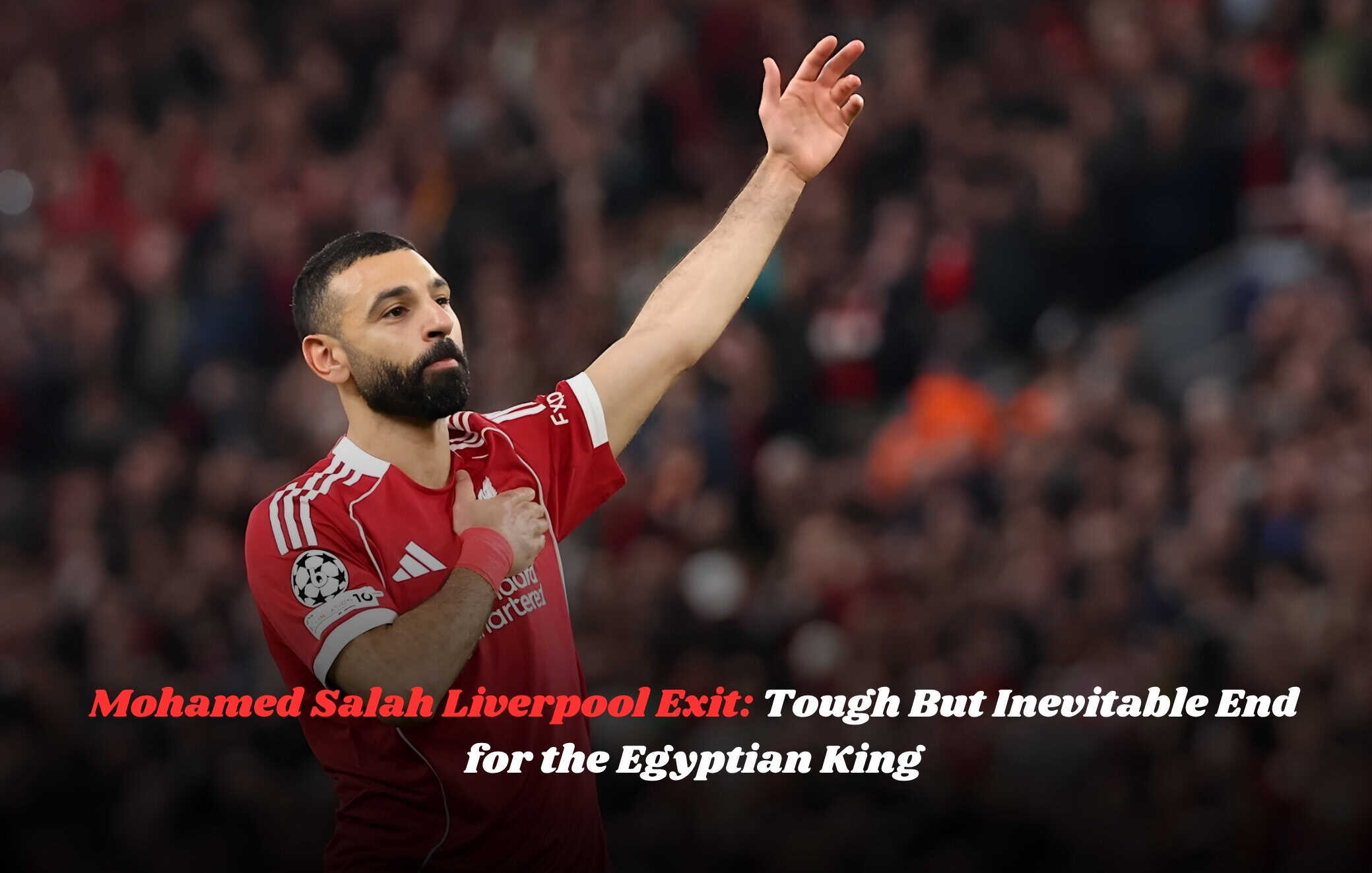
Mohamed Salah Confirms Liverpool Departure at End of 2025-2026 Season
Mohamed Salah has confirmed that the current campaign will be his last at Liverpool, bringing to a close one of the most extraordinary and celebrated individual careers in the history of English football with a farewell that carries both the weight of everything he has achieved and the unmistakable ache of an ending that arrived earlier and under circumstances more complicated than anyone associated with the club could have anticipated when he signed a contract extension as recently as the summer of 2024.
The 33-year-old confirmed his departure on his own social media channels, describing the announcement as the first part of his farewell and requesting that the club make the news public as early as possible out of respect for the supporters who have idolised him across nine seasons of performances that have consistently redefined the parameters of what it means to be an elite attacking player in the Premier League era.
At most, Salah will pull on the Liverpool shirt a further fifteen times between now and the end of the season, with the club still competing in the Champions League and FA Cup under Arne Slot, giving the Anfield faithful a small and precious number of remaining opportunities to witness in person a footballer who has given the club, the city and the sport more than most players deliver across an entire career.
The news itself arrives without genuine surprise given the manner in which events have unfolded across the course of the season, but the confirmation nonetheless lands with the full emotional force that only the departure of a truly transformative figure can generate among a fanbase as passionate, knowledgeable and deeply invested in their club’s identity as Liverpool’s.
Salah’s social media announcement drew an immediate and overwhelming outpouring of appreciation, affection and tribute from supporters, peers and observers across the global football community, with a scroll through the comments section of his departure post providing a vivid and immediate illustration of the extraordinary depth of feeling that his nine years at Anfield have generated in people who have watched him week after week, season after season, delivering performances of a quality and consistency that the sport rarely produces.
His agent Ramy Abbas was measured and deliberate in his response to the confirmation, stating that neither he nor anyone else yet knows where Mohamed Salah will play his football next season, a carefully worded declaration that leaves the final chapter of his playing career open while closing definitively the Liverpool chapter that has defined his legacy and his place in football history.
A Career at Liverpool That Defies Superlatives
When the full statistical record of Mohamed Salah’s Liverpool career is set out in its entirety, the numbers carry a weight and a significance that goes beyond simple accumulation to tell the story of a player who has operated at a level of sustained excellence that the Premier League era has never previously witnessed from a single outfield player across an equivalent period of time.
Since joining from AS Roma in 2017, no player in the Premier League has scored more goals than Salah’s 189 or provided more assists than his 92, a dual contribution of attacking quality that reflects not merely a prolific goalscorer but a complete and devastatingly effective attacking force whose influence on matches extended to every phase of Liverpool’s offensive play across nearly a decade of elite competition.
His tally of 255 goals for Liverpool across all competitions places him third in the club’s all-time scoring list behind only the legendary Ian Rush and Roger Hunt, two figures whose names carry the weight of Liverpool’s most celebrated historical eras, making Salah’s achievement of reaching that company all the more extraordinary given that he arrived at the club as a wide forward rather than as a central striker and built that record from a position that historically produces far lower goal tallies than the traditional number nine role.
The individual accolades that have accumulated across Salah’s Liverpool career represent a body of recognition without parallel in the modern Premier League, beginning with a record four Premier League Golden Boots that place him categorically beyond any previous recipient of that award in terms of the sustained frequency with which he has topped the division’s goalscoring charts.
His three PFA Players’ Player of the Year awards, voted for by his fellow professionals rather than by media panels or supporters, carry a particular and meaningful weight as expressions of peer recognition from the individuals best placed to assess on a daily competitive basis the quality and impact of what Salah brings to the game, and receiving that honour three times across his Liverpool career speaks to a consistency of performance that has compelled even the players who compete against him week after week to acknowledge his superiority.
The sight of Salah scoring and then performing the Sujood, kneeling and bowing his head to the floor in the Islamic act of prostration, has become one of the most iconic and instantly recognisable images in Premier League history, a moment of personal faith expressed publicly and without compromise that has resonated deeply with supporters around the world and contributed to a cultural significance that extends well beyond football into the broader conversations about identity, representation and belonging that elite sport increasingly reflects and shapes.
The Trophy Cabinet That Tells the Full Story
The collective honours that Mohamed Salah has accumulated during his time at Liverpool provide the definitive evidence that his individual brilliance was not merely a statistical phenomenon achieved in isolation from the team’s broader competitive success but was instead one of the primary driving forces behind the most trophy-laden period in the club’s history across recent decades.
Salah arrived at Liverpool in 2017 with the explicit ambition of winning trophies, declaring in his first interview with the club that he would give everything and wanted to win something for Liverpool, a commitment he has honoured to a degree and on a scale that even the most optimistic assessment of his potential could not realistically have predicted at the time of signing.
When Salah’s Liverpool teammate Milos Kerkez posted a photograph of Salah’s trophy cabinet on Instagram, the social media response reflected the scale of what had been accumulated, with the running joke that Salah collects player of the match awards with the casual frequency of retrieving items from a vending machine capturing in a single image the almost absurd regularity with which he has been recognised as the outstanding individual performer in the matches he has played across his Liverpool career.
The full range of honours won during Salah’s time at Anfield encompasses the Champions League, the Premier League title, the FA Cup, the League Cup and the Club World Cup, a collection that represents every major honour available to a player competing in English football and on the European stage, and that stands as the most comprehensive individual trophy haul assembled by any Liverpool player across the modern era of the sport.
Those honours were not achieved simply with Salah as a supporting presence within successful teams but were in many cases delivered directly and decisively by his goal contributions, match-winning performances and the sustained competitive excellence that made Liverpool one of the two or three best teams in world football at the peak of the Klopp era.
Regardless of the manner in which his Liverpool story is ultimately concluding, the competitive legacy is one of total fulfilment, with Salah having delivered on every ambition he expressed upon joining the club and having done so in a manner that has permanently and indelibly changed the standards by which attacking players in the Premier League will be measured and evaluated for generations to come.
How the Relationship With Liverpool Began to Fracture
The circumstances that have led to Mohamed Salah leaving Liverpool in the summer of 2026 are rooted in a sequence of events that began with what appeared on the surface to be a straightforward managerial decision but which ultimately exposed a fundamental and irreconcilable divergence between Salah’s understanding of his status at the club and the new competitive and strategic direction being pursued by Arne Slot and the Liverpool hierarchy as they invested heavily and deliberately in reshaping the squad’s attacking identity.
The first seed of discontent was planted in October when Salah was benched for a Champions League fixture away at Eintracht Frankfurt, a match Liverpool won 5-1 without him, a result that Slot cited as justification for the selection but which Salah experienced as a statement of intent about his diminishing certainty as a guaranteed starter in the team’s most important competitions.
For a player who had delivered the level of consistent excellence that Salah had produced across his entire Liverpool career, the experience of being left out of a Champions League fixture carried a significance that went beyond the individual game to signal a broader shift in his standing within the squad and the manager’s thinking that Salah found genuinely difficult to accept and ultimately impossible to accommodate within his own understanding of what his continued commitment to the club warranted.
The context of Liverpool’s summer transfer activity in 2025 made the direction of that shift unmistakably clear to everyone within the club and to the wider football world observing from the outside, with the decision to invest £450 million in the acquisitions of Alexander Isak, Florian Wirtz and Hugo Ekitike representing an explicit and enormously expensive statement of intent about the attacking strategy Arne Slot and sporting director Richard Hughes intended to pursue in building Liverpool’s competitive identity for the years ahead.
Salah, whose own performances across the previous season had topped both the Premier League goalscoring and assist charts and whose quality remained undeniably at an elite level, nonetheless found himself confronting the unavoidable reality that the club he had served with such extraordinary distinction for nearly a decade had decided that the future of their attacking play would be built around players other than himself, a conclusion that was delivered to him directly and explicitly in meetings with Liverpool’s hierarchy including sporting director Richard Hughes where it was outlined that he could expect to be benched with increasing regularity.
The gap between that institutional reality and Salah’s own assessment of what his record and his continued quality justified in terms of playing time and competitive status was one that no amount of diplomatic communication or managerial sensitivity could ultimately bridge, creating the conditions for the explosive interview at Leeds that changed the nature of his final season at the club irrevocably.
The Leeds Interview That Changed Everything
The mixed zone interview at Leeds United that Mohamed Salah gave following a Premier League fixture at Elland Road became the pivotal and defining moment of his final Liverpool season, a public declaration of dissatisfaction and fractured relationships that crossed a threshold of candour rarely seen from an active player at a club of Liverpool’s stature and that immediately transformed the dynamics of what had been a simmering situation into an open and very public dispute.
Salah claimed explicitly that his relationship with Arne Slot had broken down and that someone within the club wanted him out, statements of extraordinary directness from a player who had previously maintained a carefully managed public persona and who chose Elland Road as the moment and the venue for a disclosure that those close to him say he had always intended to make regardless of the result, suggesting a premeditation and personal certainty about the need to speak publicly that reflects how deeply the preceding months had affected him.
The consequences of the interview were immediate and significant, with Salah being benched and subsequently left out of the squad entirely in the period that followed, including being left behind for Liverpool’s trip to Inter Milan in the Champions League, a punishment whose symbolic weight in the context of a player of his stature and record was not lost on anyone observing the situation from within or outside the club.
The weeks leading up to that explosive declaration had been marked by a growing and privately painful sense of disillusionment, with Salah left upset following direct meetings with the Liverpool hierarchy, including sporting director Richard Hughes, in which it was made explicitly clear that benching would become a regular feature of his experience at the club rather than an occasional managerial decision.
Three days after his omission from the Inter Milan trip, Salah came off the bench against Brighton and contributed an assist, with Arne Slot declaring post-match that there was no issue to resolve, a statement whose diplomatic intent did little to address the fundamental structural reality that had by that point made Salah’s departure at the end of the season a near certainty rather than a possibility.
The period that followed, encompassing Salah’s departure for the Africa Cup of Nations while the club held talks with his agent Ramy Abbas, culminated in the development of what those close to the situation described as a verbal agreement between player and club to part ways at the end of the season, a quiet and private resolution of a situation that had briefly and dramatically become one of the most publicly discussed stories in European football.
The Contract Extension That Now Reads as the Final Chapter
The contractual backdrop against which Salah’s Liverpool exit is unfolding carries its own layer of complexity and irony, given that less than a year before the announcement of his departure he had been sitting on a throne inside Anfield having renewed his contract and committed his immediate future to a club whose direction, as subsequent events have demonstrated, was already moving away from the model of which he was the central and defining figure.
His previous deal had been set to expire in 2025 but the quality and consistency of his performances across the preceding season, which saw him top both the goalscoring and assist charts in the Premier League, gave the Liverpool hierarchy no viable alternative but to offer him a new contract, with the renewal being celebrated at the time as the resolution of a protracted negotiation and the securing of an irreplaceable talent for a further period.
That contract, which ran until the summer of 2027, has effectively been curtailed by mutual agreement, with Salah having asked the club to make the departure announcement as early as possible out of respect for the supporters, a request that speaks to the personal generosity and awareness of those who love the club that has characterised his relationship with the Liverpool fanbase throughout his time at Anfield even as his relationship with the management structure deteriorated beyond repair.
The decision to leave on a free transfer this summer rather than completing the final year of his contract represents a practical and emotionally complex compromise between two parties who have been bound together by one of the most successful and celebrated player-club relationships in Premier League history but who have arrived at a point of fundamental incompatibility about the role that Salah would play in Liverpool’s competitive future.
For Salah, the fact that he gets to leave on his own terms and at a moment of his choosing, with the announcement made publicly and in advance rather than buried quietly at the end of a season, represents the minimum that his contribution to the club deserves and a form of farewell dignity that the Liverpool hierarchy have ultimately extended to a player whose service warranted nothing less.
The personal dimension of his departure carries its own genuine difficulty, with Salah and his family including his wife and two daughters having built a settled and deeply rooted life in the north west of England, a life whose foundations he acknowledged openly when he said “I never imagined how deeply this club, this city, these people would become part of my life”, words that speak to an emotional investment in Liverpool that extends far beyond the professional and into the personal and familial in ways that make the departure genuinely and lastingly painful despite its inevitability.
What Mohamed Salah Leaves Behind
As the long goodbye begins and the final weeks of Mohamed Salah’s Liverpool career unfold across the remaining fixtures of a season that still holds meaningful competitive possibilities in the Champions League and FA Cup, the full measure of what he leaves behind is something that the club, its supporters and the broader football world will spend years and decades properly appreciating and contextualising against the full sweep of the Premier League era and the history of English football.
His 255 goals for Liverpool place him in the company of the club’s greatest ever goalscorers, a distinction whose weight is amplified by the fact that he achieved it as a wide forward rather than a central striker, in a period of football where defensive and tactical sophistication has made consistent goalscoring at the elite level more demanding than at any previous point in the game’s history.
The combination of goals, assists, trophies, individual awards and the cultural significance of his presence as one of the sport’s most globally recognised and admired Muslim athletes creates a legacy of extraordinary breadth and depth that belongs not merely to Liverpool Football Club but to the Premier League, to English football and to the sport itself as a universal language that connects people across boundaries of culture, geography and identity.
The Anfield faithful will get their final opportunities to serenade their Egyptian King across the remaining home fixtures of the season, occasions that will carry the specific emotional charge of genuine and irreversible farewell that only the departure of a truly exceptional and deeply beloved player can generate.
The tributes that will continue to accumulate between now and his final appearance in the red shirt will reflect the full depth of feeling that nine years of extraordinary performances have created, and the fondness and respect of his departure stands in striking contrast to the complicated and at times painful circumstances that made it inevitable.
Mohamed Salah came to Liverpool in 2017 as a 25-year-old with the ambition to win and the commitment to give everything, and he has delivered on both promises to a degree and on a scale that ensures his name will be spoken with reverence at Anfield for as long as the club exists, a legacy earned entirely through the quality of his football, the force of his character and the depth of his connection to a club and a city that he has made unmistakably and permanently his own.
🔗 Visit our other platforms:
8jjSports.com