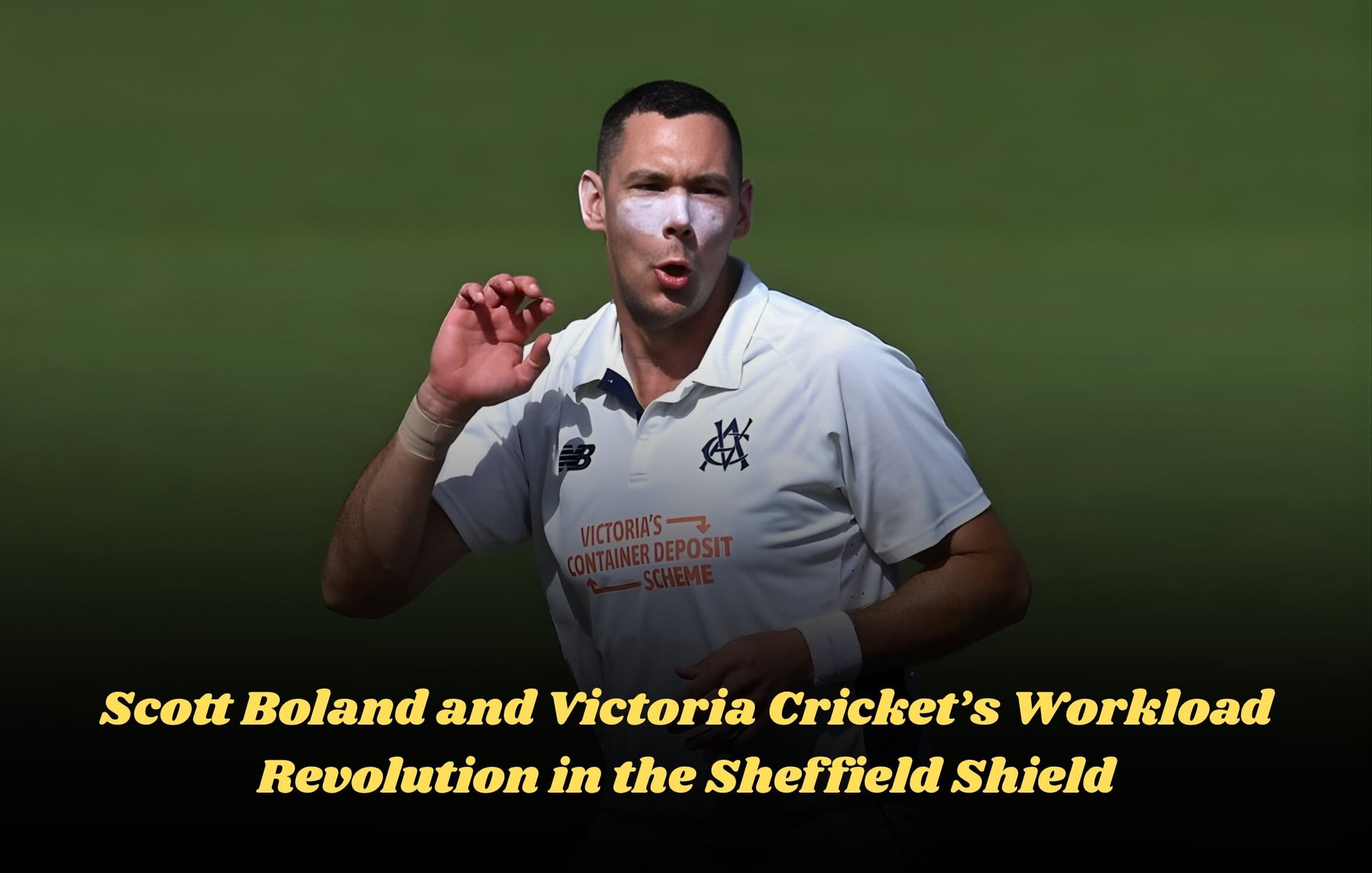
Scott Boland and the Evolution of Fast Bowling Workload Management
Scott Boland’s 2026 season stands as a defining case study in how elite fast bowlers are being managed in modern cricket, particularly within the demanding structure of Australia’s domestic Sheffield Shield system. At 36 years of age, Boland is no longer operating under the traditional expectations of relentless bowling volume. Instead, his role within the Victoria cricket setup reflects a carefully calibrated balance between performance output and physical preservation, shaped by both experience and necessity.
Having played a central role in Australia’s 4–1 Ashes series victory, where he featured across all five Tests, Scott Boland entered the domestic season carrying a significant physical and mental workload. However, rather than showing signs of fatigue, he has transitioned into the Sheffield Shield phase with renewed efficiency, a development he attributes directly to a modified approach to workload distribution. His ability to remain effective after a high-intensity international campaign highlights a broader evolution in fast bowling management across Australian cricket.
The modern demands placed on fast bowlers are no longer defined purely by match appearances but by cumulative stress cycles, recovery windows, and targeted performance peaks. Boland’s season reflects this shift. Rather than bowling excessively in training or overextending in lower-intensity fixtures, his preparation has been structured around preserving high-intensity output for match-critical moments. This approach has allowed him to maintain a wicket tally of 26 at an outstanding average of 14.62 for Victoria, reinforcing the effectiveness of strategic workload control.
What makes Scott Boland’s situation particularly notable is how it contrasts with traditional fast bowling culture, where repetition and volume were once considered essential to maintaining rhythm. Boland himself acknowledges that earlier in his career, he equated workload with readiness. However, his current philosophy prioritises freshness over volume, with a clear preference for entering matches slightly undercooked rather than fatigued. This adjustment has had a direct impact on his consistency and durability across the season.
Scott Boland and the Physical Strategy Behind His 100th Sheffield Shield Appearance
Scott Boland’s upcoming 100th Sheffield Shield appearance marks not only a personal milestone but also a validation of his long-term physical strategy. The milestone is significant within Australian domestic cricket, where longevity in fast bowling is increasingly rare due to the physical intensity of the format. Boland’s ability to reach this point while remaining a leading wicket-taker for Victoria underscores the success of his adjusted training and recovery model.
A key element of his approach has been structured rest periods integrated between competitive phases. Following the Ashes series, Boland deliberately stepped away from continuous bowling loads, allowing his body to recover from the accumulated stress of five consecutive Test matches. This period of controlled inactivity was not viewed as a setback but rather as a performance investment phase, designed to extend his effectiveness deeper into the domestic season.
Upon returning to the Sheffield Shield circuit, Scott Boland immediately re-established his rhythm without requiring extended reconditioning. This seamless transition highlights the effectiveness of his current workload framework, where match readiness is maintained through targeted engagement rather than constant repetition. His comments about investing back into his body reflect a mature understanding of sports science principles increasingly adopted in elite cricket environments.
Victoria’s coaching structure has also played a crucial role in enabling this approach. The management of Boland’s overs across matches has been deliberately moderated, ensuring he remains available for high-impact spells in crucial fixtures such as the Sheffield Shield final. This system has allowed Victoria to maximise his wicket-taking ability while minimising the risk of late-season fatigue, particularly important in a campaign where marginal physical decline can significantly affect performance output.
Scott Boland and the Psychological Confidence Driving Victoria’s Title Push
Beyond physical management, Scott Boland’s 2026 season is also defined by a notable shift in psychological confidence. His remarks suggest a bowler who has developed a deeper trust in his own skill set, reducing reliance on over-preparation and instead focusing on execution under match conditions. This confidence has been built over years of international and domestic experience, culminating in a more instinctive and less mechanically dependent approach to fast bowling.
Boland’s reflection on his earlier career reveals a significant transformation. He admits that in his younger years, he lacked the confidence to simply “rock up and hit the right areas,” instead feeling compelled to over-bowl in training to compensate for uncertainty. That mindset has now evolved into one of controlled efficiency, where less preparation is viewed as strategically beneficial rather than risky.
This psychological evolution has direct implications for Victoria’s Sheffield Shield final strategy. With Boland operating as the spearhead of a five-man bowling attack, his role is no longer solely about volume but about timing and impact. His ability to deliver high-quality spells at critical junctures provides Victoria with a structural advantage, particularly in tightly contested matches where breakthroughs define momentum shifts.
The confidence Boland carries into the final is also reinforced by his statistical output. A wicket tally of 26 at an average under 15 places him among the most effective bowlers in the competition this season, further validating his adjusted approach. For Victoria, this combination of experience, form, and physical readiness positions Scott Boland as a central figure in their pursuit of Sheffield Shield glory.
Scott Boland and the Internal Competition Driving Victoria’s Attack Structure
Scott Boland’s influence on Victoria’s Sheffield Shield campaign extends far beyond his personal wicket tally or workload management strategy. His presence has fundamentally shaped the internal structure of Victoria’s bowling attack, creating a selection environment defined by performance pressure, role clarity, and constant adaptation. As the team prepares for the Sheffield Shield final against South Australia, Boland stands at the centre of a unit that has evolved into one of the most balanced and competitive in Australian domestic cricket.
Victoria’s bowling group this season has not been built around a single dominant force but rather a layered system of contributors, each capable of producing match-defining spells. Scott Boland, however, functions as the stabilising reference point within this structure. His consistency allows the coaching staff, led by Chris Rogers, to rotate supporting bowlers without destabilising the overall rhythm of the attack. This has been particularly important in a season where multiple fast bowlers have produced strong individual statistics, creating difficult selection decisions ahead of the final.
The emergence of bowlers such as Mitch Perry and Sam Elliott has added complexity to Victoria’s planning. Both have produced high wicket tallies across the season, with Elliott taking 33 wickets in seven matches and Perry close behind with 32 wickets in eight matches. In a conventional system, such numbers would make selection straightforward. However, Scott Boland’s established role as a senior strike bowler shifts the equation entirely. His guaranteed presence means that the remaining bowling slots are effectively competing for complementary roles rather than frontline responsibility.
This internal competition has elevated the overall intensity of Victoria’s training environment. Boland’s influence in this context is subtle but significant. He does not dominate conversations through volume or authority but instead sets performance benchmarks through execution. Younger bowlers are forced to measure themselves against his consistency rather than his reputation. This creates a performance culture where selection is driven by sustained output rather than isolated spells of success.
From a tactical perspective, Scott Boland’s role allows Victoria to operate with a flexible bowling blueprint. He provides the foundation of control, typically tasked with maintaining pressure through disciplined lines and lengths, which enables other bowlers to attack more aggressively. This balance is crucial in red-ball cricket, where sustained pressure often leads to breakthroughs rather than isolated moments of brilliance.
Scott Boland and the Selection Dilemma Shaping Victoria’s Final Strategy
As Victoria approach the Sheffield Shield final, Scott Boland finds himself at the centre of one of the most challenging selection dilemmas the team has faced all season. The return of Fergus O’Neill into the squad introduces another high-quality bowling option, forcing the coaching staff to make difficult decisions about structure and balance. With only five frontline bowling positions available, and Boland occupying a fixed senior role, the competition effectively becomes a battle for the remaining two or three spots.
Chris Rogers and the Victoria coaching group are tasked with evaluating not just form but compatibility. Scott Boland’s presence ensures that the attack already has a proven strike and control mechanism. Therefore, the remaining selections must complement his style rather than replicate it. This strategic requirement places additional emphasis on variety, particularly in terms of pace variation, swing options, and seam movement.
Sam Elliott’s case is particularly complex. Despite being Victoria’s leading wicket-taker in terms of volume, his relative inexperience compared to others in the group introduces a strategic variable. Scott Boland’s endorsement of Elliott’s ability to produce crucial spells under pressure adds weight to his candidacy. However, the final decision is not solely about individual performance but about how each bowler integrates into a collective system designed to operate over potentially extended match conditions.
Mitch Perry presents a different type of dilemma. His ability to produce consistent breakthroughs across multiple matches makes him a strong contender for inclusion. Yet, with Boland already providing stability at one end, the selectors must determine whether Perry’s skill set is required in tandem or whether alternative balance is needed through the inclusion of Fergus O’Neill’s returning skill profile.
Scott Boland’s own perspective on this selection challenge reflects his evolution as a senior player. Rather than advocating for specific combinations, he acknowledges the difficulty faced by the coaching staff and emphasises the importance of maintaining a cohesive bowling identity. His comments highlight an understanding that modern domestic cricket is not just about individual performance but about constructing systems capable of sustaining pressure across multiple sessions.
Scott Boland and the Strategic Role of Experience in High-Stakes Matches
Experience is one of the most valuable assets in Sheffield Shield finals cricket, and Scott Boland’s career trajectory places him firmly within this category of influence. Having progressed through the domestic system to become one of Victoria’s most reliable fast bowlers, Boland brings a level of situational awareness that younger bowlers are still developing. This becomes particularly important in matches where conditions, pressure, and tactical adjustments evolve rapidly over four or five days.
Boland’s experience in high-pressure environments, including international Test cricket, provides Victoria with an additional layer of strategic stability. He understands how matches shift across sessions, how pitch conditions evolve, and how bowlers must adjust their lengths and strategies accordingly. This makes him not only a performer but also an on-field reference point for tactical decision-making.
In the context of the Sheffield Shield final, Scott Boland’s experience becomes even more critical given the unpredictable nature of multi-day domestic finals. Unlike bilateral international series, where conditions and opposition are more familiar, Shield finals often present fluctuating scenarios that require rapid adaptation. Boland’s ability to read these changes and adjust his bowling accordingly gives Victoria a competitive edge in tight phases of the match.
His influence also extends into the psychological preparation of the squad. Younger bowlers benefit from observing his calm approach to high-stakes cricket, particularly his ability to separate preparation from execution. This mental discipline is increasingly seen as a defining factor in elite fast bowling, where emotional control can often determine performance outcomes under pressure.
Scott Boland’s presence in the final therefore represents more than just bowling capability. It embodies a structural advantage for Victoria, combining tactical awareness, experience, and execution reliability. As the team finalises its bowling combination, his role remains the constant around which all other decisions are made.
Scott Boland and the Match-Defining Role of Red-Ball Precision
Scott Boland enters the Sheffield Shield final as more than just Victoria’s leading fast bowler; he is the tactical anchor around which the team’s entire red-ball strategy is constructed. In a format where control, patience, and consistency often outweigh raw pace, Boland’s skill set aligns almost perfectly with the demands of a high-stakes domestic final. His ability to land the ball repeatedly in uncomfortable areas, while maintaining pressure over long spells, gives Victoria a structural advantage that is difficult to replicate.
What distinguishes Scott Boland in this context is not just his wicket-taking ability, but the manner in which those wickets are created. Rather than relying on dramatic movement or extreme pace, he operates through sustained accuracy and subtle seam positioning. This method becomes especially effective in Sheffield Shield conditions, where pitches tend to reward discipline over aggression as matches progress into deeper phases. For Victoria, this means Boland is often deployed as the bowler who sets up passages of play rather than simply finishing them.
Across the 2026 season, Boland’s numbers reinforce this tactical value. His return of 26 wickets at an average of 14.62 is not just a reflection of form but of control under varying conditions. Whether operating early with the new ball or returning for long spells later in the innings, Scott Boland has demonstrated an ability to maintain consistent threat levels without sacrificing economy or rhythm. This reliability is what allows Victoria’s captaincy group to build broader strategies around attacking bowlers at the other end.
In many ways, Boland functions as the structural constant within Victoria’s bowling plans. While other bowlers may fluctuate between attacking bursts and containment roles, he provides a baseline of pressure that rarely drops. This is particularly important in finals cricket, where momentum swings can define entire sessions. A bowler who can prevent scoring acceleration while also maintaining wicket threat becomes invaluable in controlling match tempo.
Scott Boland and Victoria’s Strategic Response to South Australia’s Challenge
Victoria’s final opponent, South Australia, presents a distinct tactical challenge that further elevates Scott Boland’s importance. As defending champions, South Australia arrive with experience in high-pressure situations and a lineup capable of counterattacking when given momentum. For Victoria, the key lies in neutralising that momentum early, and Boland is central to that objective.
Scott Boland’s role in this context is expected to focus heavily on early breakthroughs and sustained pressure during opening spells. His ability to exploit any early seam movement at Junction Oval could set the tone for the entire match. In red-ball cricket, particularly in finals, the first hour of play often determines the rhythm of the contest, and Boland’s presence ensures Victoria enter that phase with a proven wicket-taking option operating at full control.
South Australia’s batting unit will also be aware of Boland’s ability to maintain discipline over extended periods. This psychological factor plays a significant role in finals cricket, where batters often adjust their approach not just based on conditions but on the reputation and consistency of the bowler at the other end. Scott Boland’s reputation for relentless accuracy forces opposition players into defensive decision-making earlier than they might prefer.
Victoria’s broader tactical plan will likely revolve around pairing Boland’s control with more aggressive bowling options at the opposite end. This contrast is designed to create pressure from both sides, forcing errors through sustained imbalance rather than isolated attacking bursts. In this structure, Boland is not just a participant but the stabilising force that allows risk-taking elsewhere in the attack.
Another key tactical consideration is the possibility of weather interruptions, with forecasts suggesting rain could influence the match. Scott Boland’s value increases in such scenarios, as shortened sessions often reward bowlers who can generate immediate pressure without needing extended build-up. His experience in adapting to changing match conditions makes him particularly suited to these unpredictable variables.
Scott Boland and the Evolution of Victoria’s Red-Ball Identity
Beyond immediate match tactics, Scott Boland also represents the broader evolution of Victoria’s red-ball identity. Over recent seasons, the team has shifted towards a more structured, discipline-driven approach to Sheffield Shield cricket, prioritising sustained pressure over explosive but inconsistent spells. Boland embodies this philosophy more clearly than any other player in the squad.
His approach to bowling reflects a wider cultural shift within the team. Victoria no longer rely solely on raw pace or individual brilliance to win matches; instead, they construct pressure through sustained periods of accuracy and strategic rotation. Scott Boland is central to this system because he can operate at a high level across long spells without significant variation in effectiveness.
This identity becomes particularly important in finals cricket, where emotional intensity can often disrupt technical discipline. Boland’s calm, repeatable action and measured approach provide a stabilising influence on the entire bowling unit. Younger bowlers in the squad benefit from this presence, not just in terms of guidance but through observation of how elite-level consistency is maintained under pressure.
His experience also contributes to Victoria’s adaptability across different match scenarios. Whether defending a low total or attacking a fragile batting lineup, Scott Boland’s role remains consistent: maintain pressure, force errors, and reduce scoring opportunities. This consistency allows the coaching staff to build flexible plans around him without compromising structural integrity.
As Victoria prepare for the Sheffield Shield final, Boland’s influence extends beyond statistics and into identity formation. He represents a model of modern fast bowling that prioritises sustainability, intelligence, and situational awareness. In many ways, he is not just part of Victoria’s attack but the framework that defines it.
Scott Boland and the Championship Moment Defining a Season
As Victoria prepare for the Sheffield Shield final, Scott Boland stands at the centre of a campaign that has been defined by consistency, control, and calculated endurance. This final is not just another match in a long domestic season; it represents the culmination of months of sustained performance management, tactical refinement, and collective ambition. For Boland, it is also a defining opportunity to translate individual excellence into team silverware in one of Australian cricket’s most demanding competitions.
The significance of this moment is heightened by Victoria’s dominance throughout the season. Their rise to the final has been built on a foundation of disciplined bowling performances, with Scott Boland consistently providing the structural backbone of their attack. His ability to maintain pressure across long spells has allowed Victoria to control matches even when conditions have not fully favoured their bowlers. This control-based identity has been one of the defining features of their campaign.
Boland’s contribution of 26 wickets at an average of 14.62 is not merely statistical success; it reflects a sustained period of influence across multiple match scenarios. Whether operating with the new ball or returning during critical middle sessions, he has remained Victoria’s most reliable point of execution. This reliability becomes even more important in a final, where small margins often determine outcomes.
The Sheffield Shield final also represents a broader test of endurance for Scott Boland, who has managed one of his heaviest workloads in recent years. Having already played a full Ashes series before transitioning into domestic cricket, his ability to maintain performance levels speaks to both physical conditioning and strategic workload management. Rather than declining late in the season, Boland has peaked at the right time, which is often the defining factor in championship-winning teams.
Scott Boland and the Pressure Dynamics of Finals Cricket
Finals cricket introduces a different psychological and tactical environment, and Scott Boland’s experience becomes especially valuable in this context. Unlike regular-season matches, where recovery and adjustment phases are more forgiving, finals demand immediate intensity and sustained focus across all sessions. Boland’s career experience, including exposure to Test cricket pressure, positions him as one of Victoria’s most composed operators in high-stakes conditions.
One of the key challenges in finals cricket is managing momentum shifts. Teams often experience rapid changes in control, where a single partnership or spell can redefine the entire match trajectory. Scott Boland’s role in Victoria’s strategy is to minimise these fluctuations by maintaining consistent pressure regardless of match situation. His disciplined line-and-length approach reduces scoring opportunities and forces batters into extended periods of defensive decision-making.
This type of control becomes particularly important against a South Australia side known for resilience and counterattacking ability. In such scenarios, Boland’s ability to restrict scoring while creating wicket-taking opportunities through patience becomes central to Victoria’s overall game plan. Rather than relying on explosive spells, Victoria depend on sustained pressure cycles, with Boland anchoring these phases.
Another important aspect of finals cricket is adaptability. Conditions at Junction Oval may shift depending on weather, pitch wear, and overhead conditions. Scott Boland’s experience allows him to adjust his lengths and angles without disrupting his core rhythm. This adaptability ensures that Victoria retain a consistent bowling threat even as external conditions evolve throughout the match.
The psychological aspect cannot be ignored either. Boland’s calm presence on the field has a stabilising effect on younger bowlers within the squad. In high-pressure environments, this composure helps maintain discipline across the bowling unit, reducing the likelihood of over-aggression or loss of structure. This intangible influence often proves decisive in closely contested finals.
Scott Boland and the Legacy of a Defining Sheffield Shield Season
Regardless of the outcome of the final, Scott Boland’s 2026 Sheffield Shield season already stands as one of the most complete domestic campaigns of his career. It represents a convergence of experience, fitness management, and tactical maturity that has allowed him to remain effective deep into a demanding schedule. His evolution as a bowler reflects broader changes in how fast bowling is managed at elite levels of cricket.
Victoria’s campaign has also highlighted the importance of structured team building around experienced performers. Scott Boland’s role has not been isolated but integrated into a wider system that values balance, depth, and adaptability. This system has enabled Victoria to reach the final with a cohesive identity built around disciplined bowling and controlled execution.
For Boland personally, this season reinforces his value not only as a wicket-taker but as a cornerstone of Victoria’s red-ball philosophy. His ability to combine physical sustainability with high-performance output places him among the most reliable fast bowlers in Australian domestic cricket. More importantly, it demonstrates that modern fast bowling success is increasingly defined by intelligence and management rather than sheer volume alone.
As the Sheffield Shield final approaches, Scott Boland remains central to Victoria’s hopes of securing the title. His role is both practical and symbolic: practical in his ability to take wickets and control runs, and symbolic in representing the discipline and structure that have carried Victoria to this stage. In many ways, he embodies the difference between a strong season and a championship-winning one.
The final will ultimately determine Victoria’s success, but Scott Boland’s influence on their journey is already undeniable. His performances, leadership through example, and strategic importance ensure that this season will be remembered as one where experience and control shaped the outcome of a campaign built on precision.
🔗 Visit our other platforms:
8jjSports.com